Loading
Making heavy industry cleaner, sustainable, more profitable.

Category: Valkyrie

33 posts

Acid gas, also known as amine overhead gas, is a blend of acidic gases including carbon dioxide (CO2) and hydrogen sulfide (H2S), and a common byproduct of various industrial processes, including natural gas processing, refining and chemical production. These gases are considered “acidic” because they can dissolve in water to form acids, leading to a decrease in pH when released into the environment. These gases, known for their corrosive properties, pose significant risks to the environment, human health and industrial equipment if not properly managed.

Where Acid Gas Comes from – Amine Sweeting

In many industrial settings dealing with sour gas, sweetening processes are employed to remove hydrogen sulfide (H2S) using methods like amine scrubbing. Amine gas treating, or sweetening, is frequently used in high volume applications, such as natural gas processing plants and refineries. Amine sweetening systems, however, generates an acid gas stream that requires careful handling and disposal.

Traditional Acid Gas Disposal Methods (Pros/Cons)

Traditional methods of disposing of acid gas include flaring and injection into specialized Acid Gas Injection (AGI) wells.

Flares and Enclosed Combustors:

  • Pros: Flaring is simple and can use existing infrastructure.
  • Cons: Key drawbacks include the fact that flaring may not be a permitted use in some jurisdictions and burning acid gas produces harmful SO2 emissions.

Acid Gas Injection (AGI) Wells:

  • Pros: Can be safe and a permanent solution.
  • Cons: AGI may not be permitted in some jurisdictions, permitting may take 1-3 years, if at all. Additionally, it is expensive to get started and requires ongoing monitoring of the potential impact on groundwater and other long-term environmental concerns. AGI wells also present a potential single point of failure, increasing the risk of unplanned downtime.

Liquid Redox for Acid Gas Treating

Next generation Liquid Redox technology offers a revolutionary approach to acid gas treatment by utilizing a Reduction-Oxidation (Redox) chemical reaction. Acid gas containing H2S exits the Liquid Redox system sweet (without H2S) and the elemental sulfur is filtered out of the regenerated chemistry where it can be reused, further reducing costs. The sulfur can be used for organic food production. This process not only eliminates the need for flaring or AGI but also delivers pure CO2 for carbon capture and storage (CCS).

  • Pros: Eco-friendly, eliminate flaring, eliminate AGI, cost-effective, deliver pure CO2 for CCS or industrial use.
  • Cons: None.

READ MORE: Streamline’s Sulfur from H2S Receives Listing as an input for Organic Food Production

VALKYRIE® Acid Gas Treating Units – Leveraging the Power of Liquid Redox Technology

VALKYRIE Acid Gas Treating Units (AGTUs) harness reliable, proven next generation Liquid Redox technology to deliver an eco-friendly solution to disposing of acid gas generated from H2S sweetening processes.

VALKYRIE AGTUs deliver these benefits:

  • Seamlessly integrate with existing H2S removal processes.
  • Can operate from 0-30 psig.
  • Can handle extremely high H2S concentrations (more than 80%).
  • Offer little to no pressure drop across the unit.
  • Effectively eliminates all remaining H2S from the gas stream and delivers elemental sulfur.
  • Ensure compliance with regulatory standards.

LEARN MORE: VALKYRIE® Gas Treating Technology

READ MORE: Streamline’s Sulfur from H2S Receives Listing as an input for Organic Food Production

CCS Benefits

VALKYRIE AGTUs using next generation Liquid Redox chemistry deliver a multitude of benefits to CCS efforts:

  • Eliminates flaring of acid gas and associated emissions.
  • Eliminates need for an Acid Gas Injection (AGI) well.
  • Delivers pure CO2 for multiple uses, including CCS.
  • Pure CO2 for CCS increases storage capacity and maximizes carbon credits (45Q tax credit) .
  • Qualify for clean energy tax credits.

LEARN MORE: 45Q Tax Credit for Carbon Oxide Sequestration

LEARN MORE: IRA (Inflation Reduction Act) Tax Credit

The VALKYRIE Acid Gas Treating Advantage

VALKYRIE stands out as a true green solution with its use of non-toxic, eco-friendly chemicals and renewable or low-impact resources. Its energy efficiency, reduced waste generation, and compliance with regulations make it a cost-effective and environmentally responsible choice for acid gas treatment.

Advantages of VALKYRIE AGTUs for acid gas treating:

  • A true green solution with non-toxic and eco-friendly chemicals
  • Renewable or low-impact resources
  • Energy efficiency
  • Reduced waste and generation of byproducts
  • No harmful byproducts
  • Recyclability or reusability
  • Cost-effectiveness
  • Compliance with regulations

Summary

VALKYRIE liquid redox technology offers a sustainable and efficient solution for treating acid gas, mitigating environmental risks, and promoting carbon capture initiatives. By harnessing the power of chemistry, it not only addresses industrial challenges but also paves the way for a greener, more sustainable future.

Contact us today to learn more about Next Generation Liquid Redox H2S treating technology and determine if the VALKYRIE system is right for your operation.

About Streamline Innovations

Streamline Innovation’s vision is Reducing Emissions Through Technology.  We help heavy industry around the world achieve environmental performance objectives, improve sustainability, and transition to a sustainable, low-carbon economy.

H2S is present in almost every industrial process in the world.  Our technology can be applied across industries, delivering a sustainable solution that eliminates H2S, the leading cause of acid rain, a deadly greenhouse gas dangerous for work and living environments.

Streamline believes that achieving the E (“Environmental”) in ESG requires data. Creating intelligent systems that operate effectively and efficiently without human intervention is critical to reducing emissions that harm the environment.   We integrate advanced data collection, process control, and analytics in our technologies to provide a total solution for customers.

We serve organizations in multiple sectors, including Energy/Oil & Gas, Biogas, Landfill Gas & Renewable Fuels, Municipal Wastewater and Industrial Air & Water.
Streamline Innovations is thrilled to announce we have achieved a significant milestone in our mission to provide eco-friendly hydrogen sulfide (H2S) treating solutions to the Oil & Gas, RNG, LFG, and CCUS sectors.  Earlier this year, we successfully deployed our 50th VALKYRIE® H2S treating system, demonstrating our growing market presence and the increasing demand for sustainable H2S treatment solutions.

David Sisk, Chief Executive Officer, said, “The deployment of our 50th VALKYRIE H2S treating system underscores the trust that our partners and customers have placed in us; we are immensely grateful for their continued support and collaboration. This achievement is a testament both to the hard work and dedication of our exceptional team, whose tireless efforts have propelled us to this significant milestone, and to the significant value our customers realize with VALKYRIE technology.

The 50th VALKYRIE plant was deployed for a new customer, one of the five new customers that we began a partnership with in 2023.  Our customer list continues to grow and our existing customers continue to expand with us as well.  Currently, many new Valkyrie systems are being fabricated as we build our inventory to ensure we can meet customer needs in a timely manner.”

The VALKYRIE H2S Treating System is an innovative solution that has redefined the landscape of hydrogen sulfide (H2S) removal in various industrial processes. It safely and efficiently eliminates H2S, a hazardous and corrosive gas, from natural gas, biogas, and CO2 streams, ensuring the highest levels of safety, environmental compliance, and operational efficiency.

What makes VALKYRIE stand out is its ability to permanently remove H2S from gas streams without generating any negative byproducts or downstream effects. Unlike traditional H2S treatment methods, VALKYRIE units employ our proprietary TALON® liquid redox chemistry, which converts H2S molecules into harmless byproducts, namely elemental sulfur—a valuable resource that can be used in organic food production.

As we celebrate this milestone, our commitment to innovation and sustainability remains unwavering. Streamline Innovations will continue pushing the boundaries in the development of clean energy solutions. Our vision is to provide our partners with cutting-edge technologies that exceed their environmental and operational objectives.

The deployment of the 50th VALKYRIE H2S Treating System is not just a milestone for Streamline Innovations; it is a win for the environment, for our partners, and for the future generations who will benefit from cleaner and more sustainable energy sources.

About Streamline Innovations

Streamline Innovation’s vision is Reducing Emissions Through Technology.  We help heavy industry around the world achieve environmental performance objectives, improve sustainability, and transition to a sustainable, low-carbon economy.

Streamline’s environmentally forward H2S treating solutions help achieve the “E” in ESG. H2S is present in many industrial processes throughout the world.  Our technology can be applied across industries, delivering a sustainable solution that eliminates H2S, a leading cause of human inhalation accidents and source of SO2 emissions, a primary cause of acid rain.  Talon treats effectively in both gas and water phases.

Streamline believes that achieving ESG directives requires data. Creating intelligent systems that operate effectively and efficiently without human intervention is critical to measuring and reducing emissions that harm the environment.   We integrate advanced process control, data collection and analytics in our technologies to provide a total solution for customers.

We serve organizations in multiple sectors, including Energy/Oil & Gas, Biogas, Landfill Gas & Renewable Fuels, Municipal Wastewater and Industrial Air & Water.
Contact

Randy Rohlfs
Chief Commercial Officer
Streamline Innovations, Inc.

randy.rohlfs@streamlineinnovations.com

Streamline Innovation’s vision is Eliminating Emissions Through Technology.  We help industry around the world achieve environmental performance objectives, improve sustainability, and transition to a sustainable, lower-carbon future.

One of the benefits of using a Streamline Innovations VALKYRIE® H2S Treating System is the positive contribution to Environmental and Sustainability directives.  Unlike like some hydrogen sulfide treatment processes that create pollution or toxic wastes, Streamline’s VALKYRIE destroys H2S, and creates elemental sulfur that can be used for soil amendment in agriculture. 

Streamline’s VALKYRIE employs TALON®, a non-toxic, biodegradable Redox (“Reduction-Oxidation”) chemistry process that removes H2S from gas streams by converting it (“reduction”) to elemental sulfur and then regenerating the chemistry by introducing air (“oxidization”) so that the chemistry can repeat the treating process, over and over again.  The elemental sulfur is filtered from the chemistry and is accumulated in a container that will be used to store and transport the sulfur.

The VALKYRIE® H2S Treating System doesn’t just capture H2S, it destroys it, eliminating the need to flare sour gas, which is critical for reducing routine flaring and SO2 emissions.

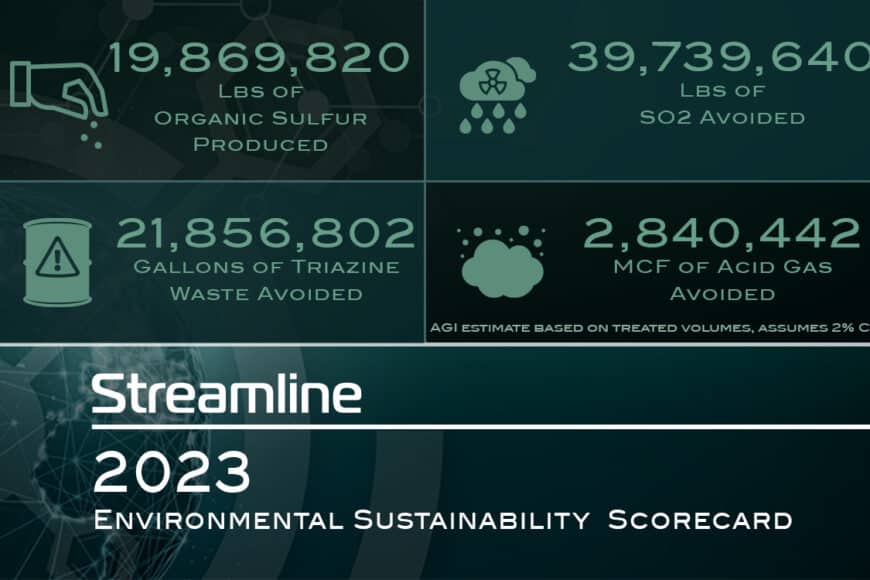
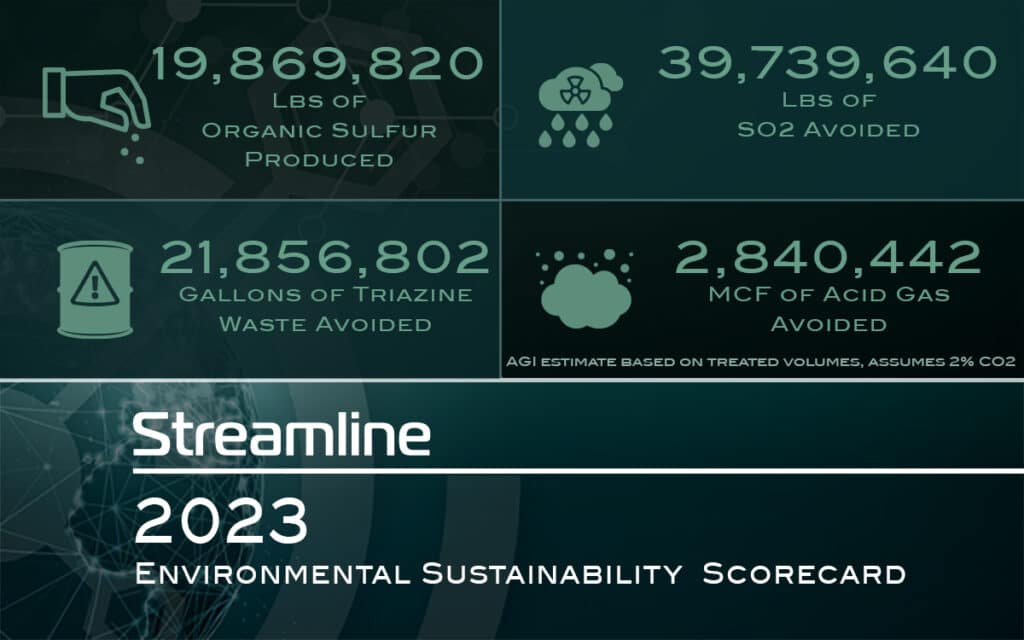
The infographic below aggregates the environmental sustainability benefits delivered to our customers by VALKYRIE units operating during 2023.

ESG Scorecard - 2023 Streamline Innovations Environmental Sustainability Scorecard

In 2023, the VALKYRIE fleet delivered substantial improvements in environmental performance, as compared to 2022:

  • 20% increase in organic sulfur production
  • 20% increase in avoided SO2 emissions
  • 20% increase in avoided gallons of triazine waste
  • 53% increase in avoided acid gas produced

“Leading E&P operators are using Streamline technology to unlock the value of their sour gas assets in a cost-efficient and environmentally friendly manner. The VALKYRIE Environmental Sustainability Scorecard demonstrates the quantifiable environmental benefits of our technology.”

– David Sisk, CEO

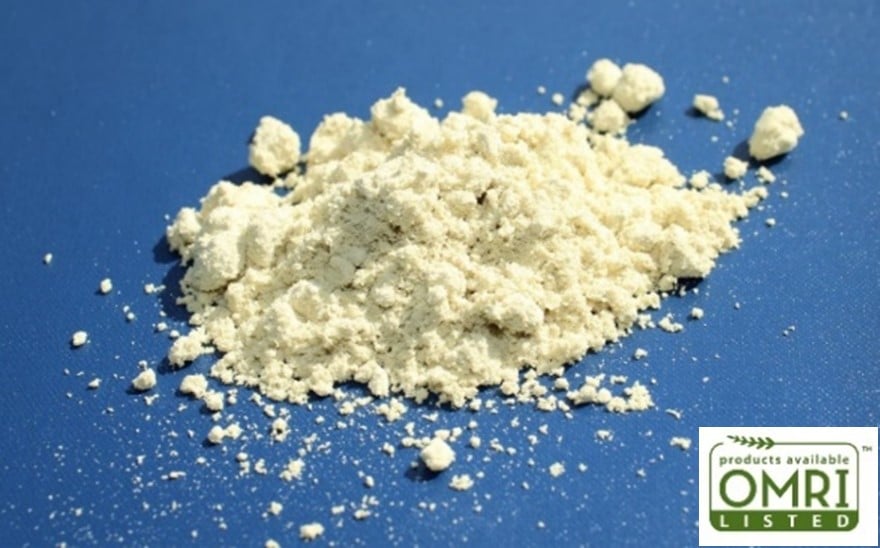
Streamline’s sulfur produced by the Valkyrie is listed as Simple Elemental Sulfur™ with the Organic Material Review Institute (“OMRI”) for use as fertilizer for Organic Production.  OMRI certification approval standards are compliant with the USDA National Organic Program (“NOP”) regulations for organic cultivation processes.  Simple Elemental Sulfur™ is a powdered, amorphous form of sulfur that can be beneficial as a soil amendment, increasing the pH of soil and improving the uptake of nitrogen. 


About Streamline Innovations

Streamline Innovation’s vision is Reducing Emissions Through Technology.  We help heavy industry around the world achieve environmental performance objectives, improve sustainability, and transition to a sustainable, low-carbon economy.

Streamline’s environmentally forward H2S treating solutions help achieve the “E” in ESG. H2S is present in many industrial processes throughout the world.  Our technology can be applied across industries, delivering a sustainable solution that eliminates H2S, a leading cause of human inhalation accidents and source of SO2 emissions, a primary cause of acid rain.  Talon treats effectively in both gas and water phases.

Streamline believes that achieving environmental sustainability directives requires data. Creating intelligent systems that operate effectively and efficiently without human intervention is critical to measuring and reducing emissions that harm the environment.   We integrate advanced process control, data collection and analytics in our technologies to provide a total solution for customers.

We serve organizations in multiple sectors, including Energy/Oil & Gas, Biogas, Landfill Gas & Renewable Fuels, Municipal Wastewater and Industrial Air & Water.
Maintaining consistent production output can be a challenge as oil and gas reservoirs age. Over time, natural reservoir pressure diminishes, causing a decrease in production rates which impacts the economic viability of older wells and the value of proved reserves. When the natural drive of a well is no longer sufficient to bring liquids to the surface, artificial lift methods become indispensable. Among these methods, gas lift stands out as a cost-effective and efficient solution.

Gas lift is an artificial lift system where natural gas is injected into the well casing to assist in lifting liquids to the surface through the production tubing. Gas lift is employed when reservoir pressure declines, water cuts increase and gas-to-oil ratios (GORs) change over time. Gas lift systems provide operators with an effective and economical means of optimizing production in a wide range of well configurations, whether they are shallow or deep, vertical or horizontal.

Benefits of Gas Lift

Gas lift has several advantages that make it a preferred choice for artificial lift operations:

  1. Low Operating Costs: Gas lift systems often use the natural gas produced from the well as fuel for compressors used to inject gas back into the reservoir, commonly referred to as “lease use” gas. This usually results in lower operating costs compared to other artificial lift methods.
  2. Minimal Downhole Equipment: Unlike some other artificial lift systems, gas lift does not require the installation and maintenance of additional downhole equipment such as submersible pumps or rods. A downhole gas lift valve and compressor are typically all that is required. This simplicity translates to reduced capital outlays for equipment and maintenance expenses.
  3. Easier Maintenance: Gas lift systems have fewer moving parts than other artificial lift methods, leading to less wear and tear. There is no risk of a broken rod downhole, eliminating the need for a workover rig to fix it. This simplicity keeps repair costs relatively low.
  4. Ease of Replacement: When flow conditions change, the gas lift valve can be replaced cost-effectively without the need for a workover rig, minimizing downtime.

Sweet Gas Buyback

One challenge in gas lift operations arises when there isn’t enough natural gas produced at the well site for use in the system, or if the produced gas is contaminated with impurities like hydrogen sulfide (H2S). Gas contaminated with H2S, commonly referred to as sour gas, poses significant challenges to system integrity and human health, making it unsuitable for gas lift operations.

In these scenarios, operators often resort to purchasing “sweet gas,” usually from their midstream partner, to fulfill their gas lift requirements, a practice known as “sweet gas buyback.” Depending on the prevailing price of natural gas, however, sweet gas buyback may be prohibitively expensive.

Fuel Gas Conditioning – Dealing with H2S

As a highly corrosive and toxic gas, H2S must be effectively removed before it can be safely used in gas lift operations. Operators with sour gas operations can avoid the expense of buying back sweet gas by treating H2S on-site. This approach not only ensures a reliable source of gas for gas lift operations but can also lead to cost savings and environmental benefits.

In areas where midstream H2S treating capacity and sour takeaway is limited, on-site sour gas treatment can remove this constraint, providing the additional advantage of using the treated gas for gas lift. Even if adequate sour gas takeaway capacity exists, on-site H2S treatment reduces or can even eliminate the expense of sour gas takeaway.

Traditionally, sour gas has been treated using various methods, such as amine gas sweetening or scavengers. These methods, while somewhat effective, have drawbacks in terms of cost, environmental impact, and operational complexity.

READ MORE: Gas Sweetening | A Comparison Guide

Next Generation Liquid Redox (VALKYRIE®)

A promising solution for treating H2S in gas lift operations is the use of Next Generation Liquid Redox, which is the basis for our VALKYRIE H2S treating technology. This innovative approach offers several benefits over traditional methods:

  1. Reduced Expense of Sweet Gas Buyback: VALKYRIE technology enables on-site treatment of sour gas, reducing or eliminating the need for expensive sweet gas buyback.
  • Reduced Expenses Associated with Sour Gas Takeaway: Operators can reduce expenses related to sour gas takeaway paid to midstream partners, leading to significant cost savings.
  • Non-Toxic and Eco-Friendly Chemicals: VALKYRIE technology employs non-toxic and environmentally friendly chemicals, minimizing harm to the environment and ensuring the safety of workers.
  • Turnkey Solution: Streamline handles all chemicals, maintenance, operations, and sulfur removal, taking away what is traditionally an operations headache for our customers.  We do this with 99+% operational uptime.
  • No Harmful Byproducts: The VALKYRIE treatment process produces no harmful byproducts, further contributing to its environmental sustainability.
  • Recyclability or Reusability: Many VALKYRIE systems allow for the recycling or reuse of chemicals, reducing waste and enhancing cost-effectiveness.

Leading operators like Chevron and Franklin Mountain Energy have been using VALKYRIE technology for years for effective H2S removal.

LEARN MORE: VALKYRIE Technology for Gas Sweetening and H2S Removal

Summary

Gas lift is a valuable artificial lift method for optimizing production in oil and gas wells. It offers numerous benefits, including low operating costs, minimal downhole equipment requirements, ease of maintenance and versatility. However, in cases where sour gas is present the expense of buying back sweet gas can pose challenges.

The use of advanced sour gas treatment technologies like VALKYRIE units offer operators a green solution for sour gas sweetening that not only ensures a reliable source of gas for gas lift but also reduces costs, minimizes environmental impact and enhances safety. Embracing these innovative technologies can lead to more efficient and sustainable gas lift operations in the oil and gas industry.

Contact us today to learn more about Next Generation Liquid Redox H2S treating technology and determine if the VALKYRIE system is right for your operation.

Contact

Jacob Pratt
SVP – Sales
Streamline Innovations, Inc.
jacob.pratt@streamlineinnovations.com

About Streamline Innovations

Streamline Innovation’s vision is Reducing Emissions Through Technology.  We help heavy industry around the world achieve environmental performance objectives, improve sustainability, and transition to a sustainable, low-carbon economy.

H2S is present in almost every industrial process in the world.  Our technology can be applied across industries, delivering a sustainable solution that eliminates H2S, the leading cause of acid rain, a deadly greenhouse gases dangerous for work and living environments.

Streamline believes that achieving the E (“Environmental”) in ESG requires data. Creating intelligent systems that operate effectively and efficiently without human intervention is critical to reducing emissions that harm the environment.   We integrate advanced data collection, process control, and analytics in our technologies to provide a total solution for customers.

We serve organizations in multiple sectors, including Energy/Oil & Gas, Biogas, Landfill Gas & Renewable Fuels, Municipal Wastewater and Industrial Air & Water.
How Byproducts of the Biogas Purification Process Create a Muddied Field

Not all RNG is created equal. “Created” being the critical word.

Renewable Natural Gas, (RNG or biomethane) is generated through a sometimes lengthy and complicated biogas upgrading process. Biogas, in its raw form, contains contaminants that can be harmful to the environment and have negative effects on pipelines, storage facilities and other infrastructure. As a result, biogas, whether it is produced from an agricultural operation or a landfill, must be purified of contaminants including H2S, oxygen, CO2, N2, siloxanes and other elements before it can be sold commercially as highly valuable “Green Power” RNG.

Although the green concept is rooted in decarbonizing energy systems by reducing Greenhouse Gas emissions, the true “greenness” of an energy operation is called into question if it generates byproducts harmful to the environment and/or simply replaces one type of emissions with another.

With this context in mind, not all H2S treatment solutions are created equal. For an RNG operation to live up to its sustainability promise, the issue of byproduct generation, especially in H2S treatment, must be addressed to ensure the holistic sustainability of energy production.

This article covers various methods for treating H2S for upgrading biogas and landfill gas to RNG and the benefits of using a green H2S solution.

The H2S Problem

Hydrogen sulfide is a common impurity in various energy sources, including fossil fuels, biogas and Landfill Gas. Treating sour gas (natural gas containing H2S) in oil and gas operations has been a priority for many decades for protecting infrastructure and ensuring operational safety (H2S presents a serious health threat to workers). H2S presents a similar challenge in upgrading biogas and landfill gas to RNG, so it can be injected into commercial pipelines for sale.

Solutions for Dealing with H2S                               

Various methods exist to remove H2S from gas streams, ranging from traditional techniques to innovative green solutions:

Traditional H2S Treating Methods

In our article, Gas Treating Solutions for Renewable Natural Gas, we covered the primary categories of gas treating to remove H2S from landfill gas, biogas and geologic sources. Conventional H2S treatment methods, including scavengers, adsorbents and catalytic reactions are plagued with a variety of downsides:

  • Create negative downstream processing effects
  • Require the use of chemicals that can be expensive and present a safety risk
  • Require the disposal of contaminated media, creating environmental and safety risks
  • Operational complexity, requiring frequent oversight on location and system maintenance

Solid Media: Activated carbon and Iron Sponge are commonly used for H2S treating in RNG operations. These materials absorb H2S, effectively removing it from the gas stream. However, they have limitations such as saturation issues, resulting in downtime for changing out spent media and the cost of disposal. Because these methods, like Triazine, create spent media cannot be recycled and must be disposed of in a landfill or other facility, they do not deserve a “green” rating.

Green H2S Treating Methods

Biologics and Next Generation Liquid Redox are significantly more green than traditional methods of treating H2S, primarily because they do not create negative byproducts.

Biological Systems: Biological processes are green because they utilize microorganisms to convert H2S into non-harmful compounds. While biological H2S treating methods are eco-friendly because most commercially available biologic H2S treating processes extract elemental sulfur from biogas, they typically require long start-up times to allow a critical mass of microorganisms to grow and are highly sensitive to changes in gas flow, temperatures, and H2S Concentrations, which can result in unplanned downtime and lengthy restarts. In addition, biologic systems typically require additional equipment to maintain a steady state, increasing the cost of these systems and adding operational complexity.

Next Generation Liquid Redox (VALKYRIE™): The next generation of liquid redox solutions, such as VALKYRIE Biogas-to-RNG technology, provide biogas and Landfill Gas operators a H2S purification solution that is not only green, but operationally robust. This innovative technology has proven itself in the fossil fuel industry and offers RNG operators an efficient and effective means of eliminating H2S from biogas and Landfill Gas without harmful byproducts. The process involves using non-toxic and environmentally friendly chemicals to oxidize H2S into Simple Elemental Sulfur™, a valuable byproduct certified by OMRI for use in organic food production. VALKYRIE technology is energy efficient, produces no harmful emissions, facilitates quick startups, and resistant to variability in gas flow rates and temperature.

These green H2S treating methods help promote and facilitate the longer-range vision of a Circular Economy where the outputs of one industrial process become the inputs of another, helping us realize a Green Future sooner than imagined. By extracting elemental sulfur from H2S, it can be returned to the soil and used for organic food production.

Learn more about our vision for A Green Future.

Benefits of VALKYRIE H2S for Biogas-to-RNG Upgrading

The adoption of the VALKYRIE ECO or VALKYRIE ECO FLEX H2S treating solutions provide biogas and Landfill Gas producers a robust, efficient and green H2S removal solution for upgrading their gas to RNG.

Benefits of VALKYRIE technology include:

  • Recyclability and reusability of byproducts like Simple Elemental Sulfur™ enhances resource utilization and create a true green solution with no harmful byproducts.
  • Treats H2S down to non-detect levels from a single skid.
  • Reliable and robust – insensitive to variability in biogas H2S concentrations and temperatures.
  • No additional conditioning equipment is needed.
  • Use of non-toxic and eco-friendly chemicals ensures minimal environmental impact.
  • Utilization of renewable or low-impact resources aligns with sustainable practices.
  • Faster startup and higher uptime when compared to biologic treating alternatives.
  • Energy efficiency is maintained, reducing operational costs and resource consumption.
  • Reduced waste generation and the generation of harmful byproducts contribute to cleaner operations.
  • Cost-effectiveness is achieved through efficient and optimized processes.

Learn more about Streamline’s VALKRYIE ECO and ECO FLEX Biogas-to-RNG Upgrading Technology.

Summary

The transition to a decarbonized global energy system is accelerating and RNG has an essential role to play, but a energy source is only as green as the byproducts it generates. Addressing the H2S problem in biogas and Landfill Gas is a significant step towards producing cleaner, upgraded RNG suitable for commercial pipelines. Traditional methods have significant limitations, but VALKYRIE technology offers RNG operators a reliable, robust, efficient, clean and holistic option aligned with green energy goals.

About Streamline Innovations

Streamline Innovations’ vision is Eliminating Emissions Through Technology. We help heavy industry around the world achieve environmental performance objectives, improve sustainability, and transition to a sustainable, low-carbon economy.

Streamline’s environmentally forward H2S treating solutions help our customers achieve the “E” in ESG. H2S is present in many industrial processes throughout the world, and our technology can be applied across industries, delivering a sustainable solution that eliminates H2S, a leading cause of human inhalation accidents, corrosion and SO2 emissions, a primary cause of acid rain.

We also believe that achieving climate-improving directives requires data. Creating intelligent systems that operate effectively and efficiently without human intervention is critical to measuring and reducing emissions that harm the environment. We integrate advanced process control, data collection and analytics in our technologies to provide a total solution for customers.

We serve organizations in multiple sectors, including Energy/Oil & Gas, Biogas, Landfill Gas & Renewable Fuels, Municipal Wastewater and Industrial Air & Water.
Contacts

General Inquiries:
Randy Rohlfs
Chief Commercial Officer
Randy.Rohlfs@StreamlineInnovations.com

Sales Inquiries:
Jacob Pratt
SVP – Sales
Jacob.Pratt@StreamlineInnovations.com

Biogas and landfill gas, generated from organic waste and decaying materials, hold tremendous potential as sustainable energy sources. To harness their full value and minimize greenhouse gas emissions, these gases can be upgraded and converted to Renewable Natural Gas (RNG). RNG, also known as biomethane, is a valuable commodity that can be sold to commercial pipelines.

In this article, we will explore the process of upgrading raw biogas and landfill gas to meet the specifications required for RNG production and distribution.

Understanding Biogas and Landfill Gas

Biogas and landfill gas are both produced through anaerobic digestion—the breakdown of organic matter in the absence of oxygen. Biogas is typically derived from agricultural waste, sewage sludge and food waste, while landfill gas is generated as a result of the decomposition of organic materials in landfills. These gases primarily consist of methane (CH4) and carbon dioxide (CO2), with smaller quantities of other gases such as hydrogen sulfide (H2S).

Challenges and Benefits of Upgrading

Raw biogas and landfill gas contain impurities such as water vapor, sulfur compounds, siloxanes and volatile organic compounds (VOCs), which need to be removed or reduced to meet the specifications required for RNG. Upgrading the gas serves several key purposes:

  1. Purity: Removal of impurities, especially H2S, ensures that RNG meets the quality standards necessary for injection into natural gas pipelines. This process maximizes the energy content and facilitates the integration of RNG into existing gas infrastructure.
  2. Environmental Benefits: Upgrading raw biogas and landfill gas significantly reduces their environmental impact. By removing impurities like CO2, RNG from Dairy and Swine feedstocks can have a carbon-neutral or even carbon-negative profile, making it an eco-friendly alternative.
  3. Financial Viability: Converting raw biogas and landfill gas into RNG enhances their economic value. RNG can be sold as a renewable energy commodity, attracting financial incentives, grants, and credits while also diversifying revenue streams for waste management facilities or biogas plant operators.

The Upgrading Process

The process of upgrading raw biogas and landfill gas involves multiple stages to achieve the desired purity and composition for RNG production. The common steps include:

  1. Conditioning: In this stage, the raw biogas or landfill gas is treated to remove moisture, particulate matter, and H2S Water vapor is condensed and removed through cooling, while solid particles are filtered out.
  2. CO2 Removal: To meet RNG specifications, the CO2 content must be reduced. Several technologies, such as pressure swing adsorption (PSA) and membrane separation, are employed to selectively remove CO2 from the gas mixture.
  3. Trace Impurity Removal: Further purification is necessary to remove trace impurities, including siloxanes and VOCs, which can cause equipment damage and reduce the quality of RNG. Technologies like activated carbon filters and thermal oxidation units are commonly used for this purpose.

The Importance of H2S Removal

Hydrogen sulfide (H2S) is a common impurity found in raw biogas and landfill gas. It is a corrosive and toxic gas that not only poses risks to equipment and infrastructure but also affects the overall quality and marketability of RNG. The presence of H2S in the gas stream can lead to operational challenges, reduced energy content, and increased maintenance costs. Therefore, effective removal of H2S is essential to meet the stringent standards required for RNG production.

Read our blog Meeting RNG Pipeline Specifications – The H2S Imperative

Traditional Techniques for H2S Removal

Several traditional techniques are employed to remove H2S from raw biogas and landfill gas during the upgrading process. Some of the commonly used methods include:

  • Chemical Absorption: Chemical absorption involves passing the gas stream through an absorbent solution that selectively reacts with H2S, forming non-volatile compounds. One widely used absorbent is amine-based compounds, such as monoethanolamine (MEA) or diethanolamine (DEA). These chemicals have a high affinity for H2S and can effectively remove it from the gas mixture. The H2S is not destroyed and must be thermally oxidized, creating air pollution, of otherwise disposed.
  • Biological Desulfurization: Biological desulfurization, also known as biodesulfurization or biogas desulfurization, employs specialized microorganisms to metabolize H2S present in the gas stream. These microorganisms convert H2S into elemental sulfur, which can be easily separated from the gas. Biological desulfurization offers an environmentally friendly and cost-effective approach to H2S removal. The primary downside to biologic methods is that they typically require a time-consuming startup period and are highly sensitive to changes in gas stream temperature, volume and composition. Surge production, for example, can overwhelm a biologic desulfurization unit resulting in extended downtime.  At lower operating pressure additional treatment might be required to meet pipeline specifications.
  • Solid Bed Adsorption: Solid bed adsorption involves using adsorbents, such as activated carbon or iron oxide-based materials, to adsorb H2S molecules from the gas stream. As the gas passes through the adsorbent bed, H2S adheres to the surface of the material, resulting in purified gas. Periodic replacement or regeneration of the adsorbent is necessary to maintain its effectiveness. Spent media must be changed and disposed of, having similar downsides to chemical absorbents.  This works well for low concentrations of  H2S, but becomes expensive, hard to change out and creates logistics headaches when  H2S concentrations are higher.

Next Generation Liquid Redox for Removing H2S in Biogas-to-RNG Upgrading

The VALKYRIE® H2S removal system from Streamline Innovations utilizes a Liquid Redox process for converting H2S into elemental sulfur and water vapor. VALKYRIE next generation Liquid Redox employs TALON® chemistry, our non-toxic, biodegradable chemistry to remove  H2S and convert it into elemental sulfur (Reduction) and then regenerated and used again by exposure to oxygen (Oxidation).

A key benefit of the VALKYRIE ECO H2S removal system is its ability to treat to non-detect levels from a single skid without any additional conditioning equipment.

Benefits of the VALKRYIE gas treating system:

  • A green solution that converts H2S  into benign substances including water and elemental sulfur
  • Universal application for biogas, landfill gas and oil and gas production
  • Widest operating envelope of any H2S Treating method extending across the full spectrum of pressures, flow rates and H2S concentrations
  • Treating to established specifications for sales pipelines, gas lift and fuel gas
  • Flexibility of placement along the production stream whether at the anaerobic digester, at a landfill, wellhead, refinery, in a direct or tail gas treating configuration
  • High turndown
  • Specialize in meeting the most stringent outlet specifications
  • Made in the USA

VALKYRIE H2S treating technology gives biogas and landfill gas producers a smart, economical and sustainable method for H2S removal in the Biogas-to-RNG upgrading process.

Learn more about Streamline’s VALKRYIE ECO and ECO FLEX Biogas-to-RNG Upgrading Technology.

Summary

H2S removal plays a critical role in the upgrading process of raw biogas and landfill gas for RNG production. By effectively removing H2S, the quality, marketability, and environmental impact of the final product are significantly improved.

Streamline VALKYRIE liquid redox technology provides biogas and landfill gas operators a proven, robust, and green method for permanently removing H2S from their RNG feedstocks.

About Streamline Innovations

Streamline Innovations’ vision is Eliminating Emissions Through Technology. We help heavy industry around the world achieve environmental performance objectives, improve sustainability, and transition to a sustainable, low-carbon economy.

Streamline’s environmentally forward H2S treating solutions help our customers achieve the “E” in ESG. H2S is present in many industrial processes throughout the world, and our technology can be applied across industries, delivering a sustainable solution that eliminates H2S, a leading cause of human inhalation accidents, corrosion and SO2 emissions, a primary cause of acid rain.

We also believe that achieving climate-improving directives requires data. Creating intelligent systems that operate effectively and efficiently without human intervention is critical to measuring and reducing emissions that harm the environment. We integrate advanced process control, data collection and analytics in our technologies to provide a total solution for customers.

We serve organizations in multiple sectors, including Energy/Oil & Gas, Biogas, Landfill Gas & Renewable Fuels, Municipal Wastewater and Industrial Air & Water.

Contacts

General Inquiries:
Randy Rohlfs
Chief Commercial Officer
Randy.Rohlfs@StreamlineInnovations.com

Sales Inquiries:
Jacob Pratt
SVP – Sales
Jacob.Pratt@StreamlineInnovations.com

  • VALKYRIE® next generation liquid redox technology is a green hydrogen sulfide (H2S) removal technology to help upgrade biogas and Landfill Gas to Renewable Natural Gas (RNG).
  • VALKYRIE H2S treatment converts hydrogen sulfide into elemental sulfur, OMRI-certified for use in organic food production.
  • VALKYRIE ECO is targeted to the agricultural biogas market and the VALKYRIE ECO FLEX is ideal for Landfill Gas applications.

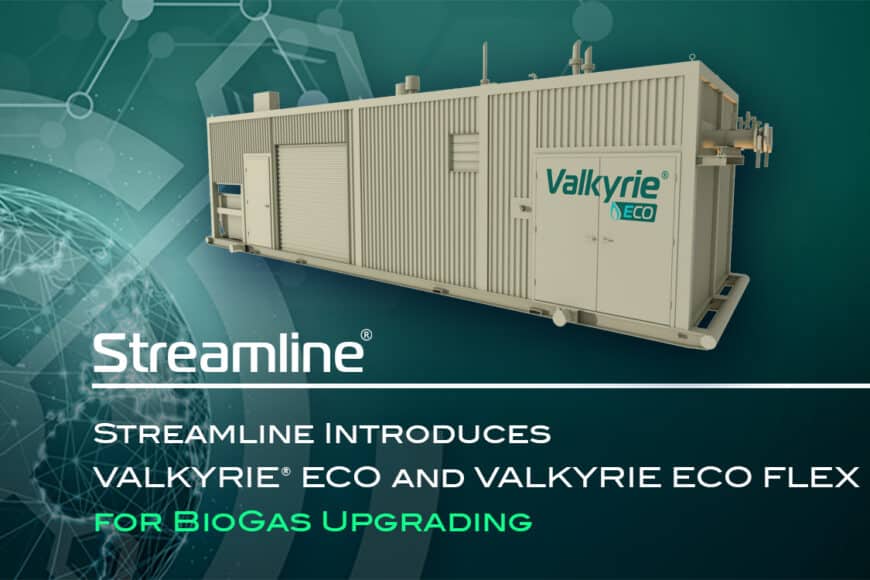
SAN ANTONIO, TEXAS, MAY 15, 2023 – Streamline Innovations, Inc. (“Streamline”) announced the introduction of the VALKYRIE® ECO and VALKYRIE ECO FLEX H2S treating solutions configured specifically for agricultural biogas and Landfill Gas (LFG) operations.

The VALKYRIE ECO model is designed for agricultural biogas applications and the VALKYRIE ECO FLEX solution is engineered for larger volume operations, such as landfills. Both units utilize TALON®, a non-toxic and biodegradable Redox chemistry to remove H2S in an environmentally responsible way.

Streamline’s products are manufactured and assembled in the USA.

The enclosed, skid-mounted VALKYRIE ECO unit is ideal for H2S removal as part of the biogas-to-RNG upgrading process.

David Sisk, Streamline’s Chief Executive Officer said, “The introduction of the VALKYRIE ECO and ECO FLEX solutions comes right as the Biogas-to-RNG market is rapidly gaining momentum. RNG project developers need a reliable, proven and environmentally sustainable solution for purifying biogas of hydrogen sulfide in the RNG upgrading process so they can sell it into commercial pipelines. VALKYRIE H2S treating technology has been working successfully for years in Oil & Gas and other industries, and its application to the RNG market is a natural extension of this innovative yet proven approach.”

Legacy methods for treating H2S have notable downsides, including handling and disposal of hazardous spent media as well as excessive downtime while biological treatment colonies repopulate. Streamline Innovation’s robust Next Generation Liquid Redox process converts H2S into elemental sulfur and water vapor. The Simple Elemental Sulfur™ byproduct is approved by the Organic Materials Review Institute (OMRI) for use in organic food production.

Both the VALKYRIE ECO and VALKYRIE ECO FLEX are designed to work effectively in the lower gas pressure environments typically found in biogas and Landfill Gas applications. Importantly, the VALKYRIE ECO FLEX model uses a modular design that allows customers to scale treating capacity in increments to meet individual LFG gas stream volumes.  

Biogas contaminated with H2S flows through the VALKYRIE H2S treating units containing specialized TALON catalyst, and then exits free of H2S, ready for additional treating to remove other contaminants such as oxygen, carbon dioxide and siloxanes, among others. The VALKYRIE ECO and VALKYRIE ECO FLEX are designed to remove H2S to levels that meet commercial pipeline specifications without additional polishing.

Visit the VALKYRIE Biogas-to-RNG web page for more information on Streamline’s green solutions for H2S treating.

About Streamline Innovations

Streamline Innovations’ vision is Eliminating Emissions Through Technology. We help heavy industry around the world achieve environmental performance objectives, improve sustainability, and transition to a sustainable, low-carbon economy.

Streamline’s environmentally forward H2S treating solutions help our customers achieve the “E” in ESG. H2S is present in many industrial processes throughout the world, and our technology can be applied across industries, delivering a sustainable solution that eliminates H2S, a leading cause of human inhalation accidents, corrosion and SO2 emissions, a primary cause of acid rain.

We also believe that achieving climate-improving directives requires data. Creating intelligent systems that operate effectively and efficiently without human intervention is critical to measuring and reducing emissions that harm the environment. We integrate advanced process control, data collection and analytics in our technologies to provide a total solution for customers.

We serve organizations in multiple sectors, including Energy/Oil & Gas, Biogas, Landfill Gas & Renewable Fuels, Municipal Wastewater and Industrial Air & Water.
Contacts

General Inquiries:
Randy Rohlfs
Chief Commercial Officer
Streamline Innovations, Inc.
Randy.Rohlfs@StreamlineInnovations.com

Sales Inquiries:
Jacob Pratt
SVP – Sales
Jacob.Pratt@StreamlineInnovations.com

The Role of Natural Gas

The move towards a decarbonized global energy system, otherwise known as the Energy Transition, is underway. In response to the concerns of key stakeholders, including the institutional investment community and regulators, energy companies are adopting initiatives to reduce emissions of Greenhouse Gasses, methane and other substances.

An important part of the Energy Transition is increasing the use of renewable energy sources, typically wind and solar, which emit zero emissions. Although renewable sources today make up less than 10% of total energy consumption in the United States, their share of the overall energy supply is rising rapidly.

Variability, however, is a critical factor hindering the widespread deployment of renewable energy sources. Because wind turbines don’t turn in calm conditions and solar panels have seasonality, can be substantially compromised on cloudy days, and do not provide power at night, these sources are not enough for long-term sustainability and reliability of the grid.

Battery storage has emerged as one solution for solving the problem of variability in renewable electricity production. Numerous battery storage projects are underway to provide long-term storage of electricity generated by renewables during ideal conditions (e.g., a bright sunny day for solar panels), so it can be supplied to the grid during peak demand.

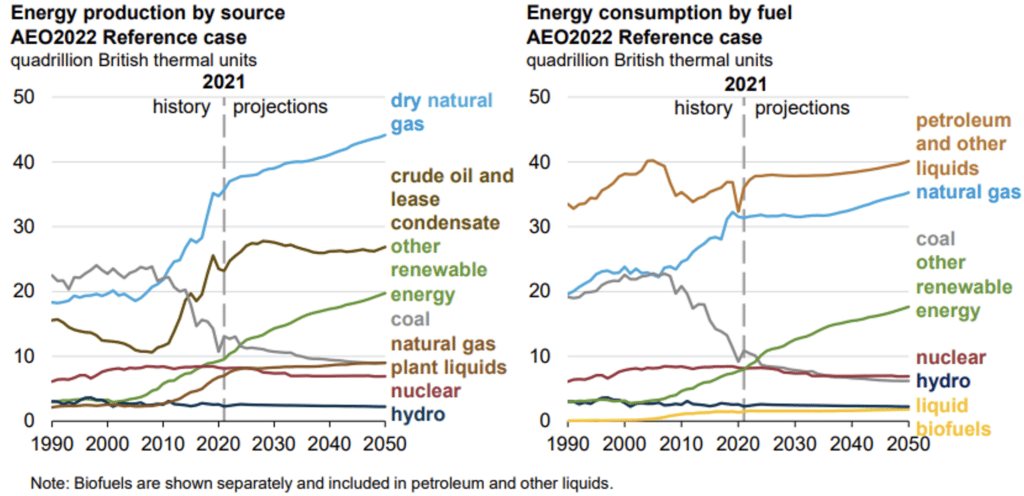
Even considering battery storage, the U.S. Energy Information Agency (EIA) forecasts that renewable energy will provide only 20% of total energy supply by 2050. Meaning, the Energy Transition, if it is to be successful, cannot rely completely on renewable energy.

Increasing Gas Consumption Driving Emissions Lower

Coal-fired power plants are major emitters of Greenhouse Gasses (GHG), primarily CO2. As a result, coal-fired plants are being phased out and being replaced by natural gas fired plants. Coal-to-gas switching is a major factor driving GHG emissions lower in the U.S.

EIA reports that emissions of CO2 have declined substantially, primarily because of power plants switching to natural gas away from coal fired power plants. Further, EIA expects adoption of natural gas for power generation to increase through 2050 as it displaces coal as a primary feedstock.

Whether natural gas is produced from geologic sources or captured from biogas operations or landfills, it burns cleaner than coal, making gas a vital component of a successful Energy Transition. But where will it come from?

The Howling Wolfcamp in the Permian Basin!

As we noted in our article Gas Treating – Processing Solutions for Multiple Industries, natural gas is expected to play a foundational role in meeting future energy consumption. In fact, the U.S. Energy Information Agency (EIA) forecasts that U.S. natural gas consumption will grow by almost 25% through 2050 and maintain the second-largest market share overall.

In the EIA’s March 2022 update, the agency provided further detail on where the growth in geologic natural gas supply is expected to come from:

  • More than half of the growth in U.S. natural gas production will be sourced from oil formations, known as associated gas.
  • The largest increase in production of associated gas is in the Wolfcamp tight oil shale formation of the Permian Basin in the U.S. Southwest.
  • The proximity of the Permian Basin in general, and the Wolfcamp formation more specifically, to LNG export terminals on the U.S. Gulf Coast in Texas and Louisiana has encouraged production growth in this region.

The Permian Basin itself is the most active oil drilling region in the U.S. As of January 27, 2023, the Baker Hughes Rig Count reported 357 rigs were working in the Permian Basin, nearly half of all working rigs in the U.S. The reason is simple – the Permian is a prolific world-class oil and gas resource.

Demand for U.S. gas exports, namely liquefied natural gas (LNG), to Europe and other developed regions lacking local energy resources, is an important driver of natural gas production growth from the Permian, including the Wolfcamp and other formations in the Permian Basin.  The nearby Eagle Ford Shale contributes significantly to the availability of gas for LNG exports.

The Sour Gas Treating Challenge

One of the challenges for oil and gas operators in the Permian Basin is gas treating for hydrogen sulfide (H2S). Much of the associated gas produced from the Permian Basin in West Texas and southeastern New Mexico and the Eagle Ford trend in southern Texas generally contains high levels of H2S, making it “sour.”

Since H2S presents a significant threat to infrastructure integrity, most pipelines have stringent limits for H2S concentration that require producers to treat sour gas to remove or destroy it. We provide more detail on natural gas pipeline gas specifications in our article Gas Treating – Processing Solutions for Multiple Industries.

Sour gas assets, typically located in established oil and gas producing regions equipped with infrastructure connecting them to national and international markets, have a critical role to play in meeting the nation’s energy needs and providing energy security. Gas treating solutions are required to unlock the value of these sour gas resources so they can be transported via pipeline, instead of burned or flared, which produces harmful sulfur dioxide (SO2).

In our article, Gas Sweetening, Sour Gas Treatment Strategies by Volume, we identified the three primary categories of traditional gas treating methods for removing H2S from associated gas, but they have numerous downsides, including:

  • Create negative downstream processing effects.
  • Require the use of chemicals that can be expensive and present a safety risk.
  • Require the disposal of contaminated media, creating environmental and safety risks.
  • Operational complexity, requiring frequent oversight on location and problem solving.

A Gas Treating Innovation – Liquid Redox

There is a proven, green solution for H2S gas treating not plagued by the downsides of traditional methods – Liquid Redox. The first generation of Liquid Redox enjoyed some mixed success treating H2S, but it was not reliable enough for large-scale applications. The next generation of Liquid-Redox gas treating for H2S, however, is a different story.

VALKRYIE® Liquid Redox (Reduction-Oxidation) technology from Streamline Innovations is based on new, updated chemistry and state-of-the-art process automation to reliably convert H2S into benign byproducts including elemental sulfur using chemistry (Reduction) that can be regenerated and be used again by exposure to oxygen (Oxidation).

The gas (i.e., Methane, CO2, other process gases) or air containing the H2S exits the system sweet (i.e., without H2S) and the elemental sulfur is filtered from the regenerated chemistry.  The chemistry is then recirculated to perform the reaction again and the sulfur is collected in a container available for use or disposal.

The Streamline VALKYRIE H2S removal system is the next generation of Liquid Redox (Reduction-Oxidation) to cost-efficiently help oil and gas operators unlock the value of sour gas resources.

The VALKYRIE system utilizes TALON® chemistry, our non-toxic, biodegradable Redox chemistry. In combination with our advanced automation and control technology, Streamline has created “The Next Generation Redox” system.

Benefits of the VALKRYIE gas treating system:

  • A green solution that converts H2S into benign substances including water and elemental sulfur.
  • Universal application for biogas, landfill gas and oil and gas production.
  • Widest operating envelope of any H2S gas treating method extending across the full spectrum of pressures, flow rates and H2S concentrations.
  • Treating to established specifications for sales pipelines, gas lift and fuel gas.
  • Flexibility of placement along the production stream whether at the anaerobic digester, at a landfill, wellhead, refinery, in a direct or tail gas treating configuration.
  • Meets the most stringent outlet specifications.

VALKYRIE gas treating units have been operating reliably for oil and gas producers in the Permian Basin and elsewhere, including Chevron Corporation and Franklin Mountain Energy among others.

Citations

EIA: Natural gas explained, Where our natural gas comes from

EIA expects U.S. natural gas production to rise as demand for exports grow

EIA: Annual Energy Outlook 2022

University of Texas Interstate Natural Gas – Quality Specifications & Interchangeability

National Energy Technology Laboratory: Reservoir Simulation of Enhanced Tight Oil Recovery: Wolfcamp Shale/Midland Basin

Streamline Innovation’s vision is Eliminating Emissions Through Technology.  We help industry around the world achieve environmental performance objectives, improve sustainability, and transition to a sustainable, lower-carbon future.

One of the benefits of using a Streamline Innovations VALKYRIE® H2S Treating System is the positive contribution to Environmental and Sustainability directives.  Unlike like some hydrogen sulfide treatment processes that create pollution or toxic wastes, Streamline’s VALKYRIE destroys H2S, and creates elemental sulfur that can be used for soil amendment in agriculture. 

Streamline’s VALKYRIE employs TALON®, a non-toxic, biodegradable Redox (“Reduction-Oxidation”) chemistry process that removes H2S from gas streams by converting it (“reduction”) to elemental sulfur and then regenerating the chemistry by introducing air (“oxidization”) so that the chemistry can repeat the treating process, over and over again.  The elemental sulfur is filtered from the chemistry and is accumulated in a container that will be used to store and transport the sulfur.

The VALKYRIE® H2S Treating System doesn’t just capture H2S, it destroys it, eliminating the need to flare sour gas, which is critical for reducing routine flaring and SO2 emissions.

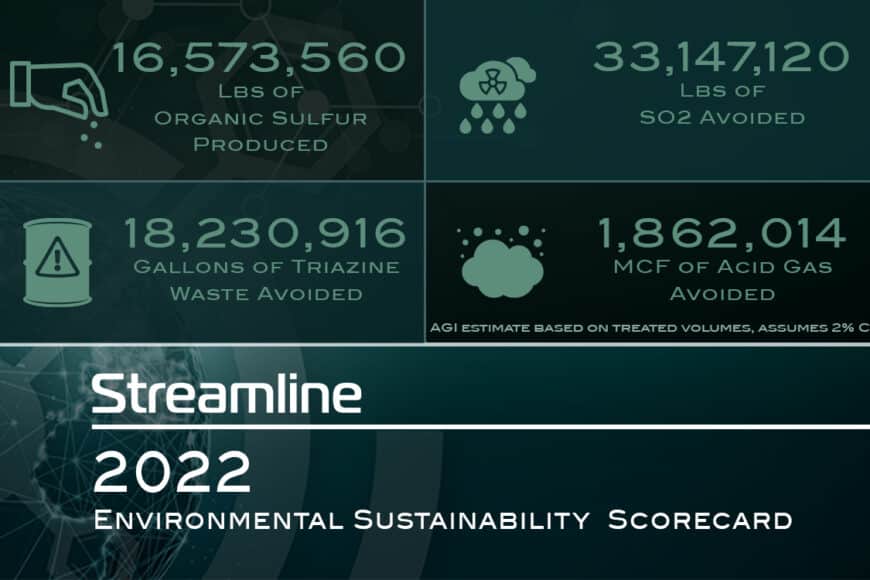
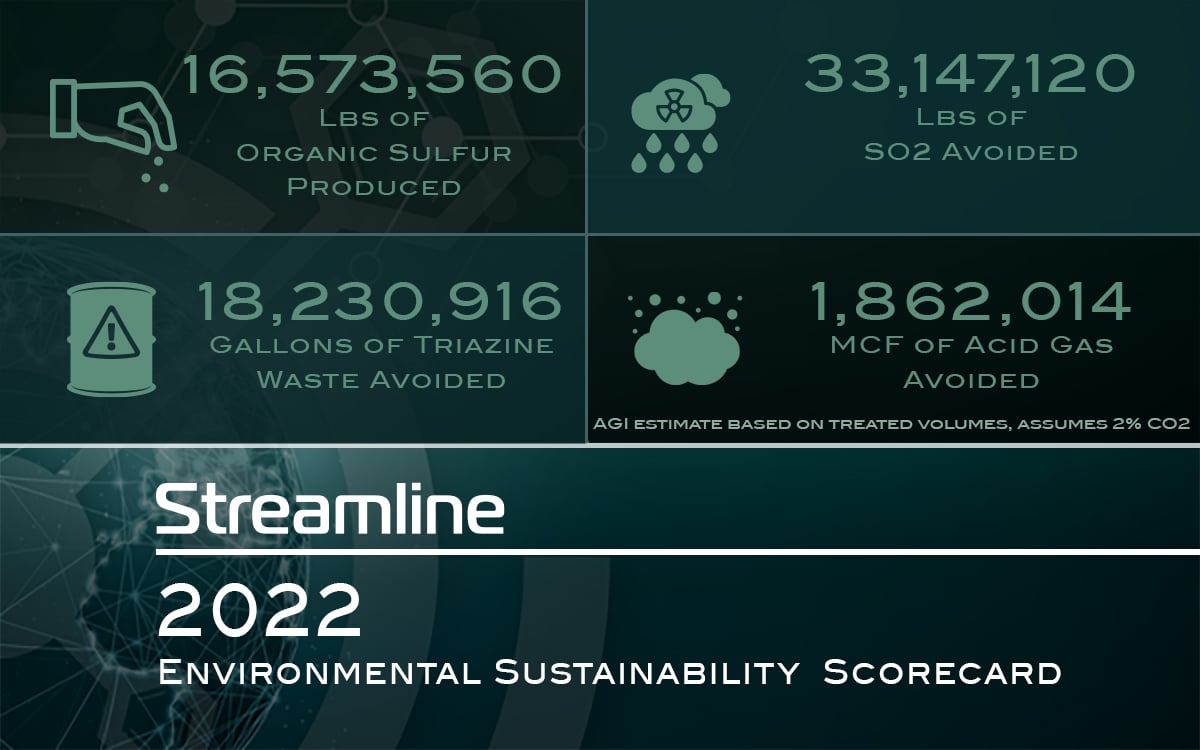
The infographic below aggregates the environmental sustainability benefits delivered to our customers by VALKYRIE units operating during 2022.

Streamline 2022 Sustainability Scorecard

In 2022, the VALKYRIE fleet delivered substantial improvements in environmental performance, as compared to 2021:

  • 42% increase in organic sulfur production
  • 42% increase in avoided SO2 emissions
  • 42% increase in avoided gallons of triazine waste
  • 38% increase in avoided acid gas produced

“Leading E&P operators are using Streamline technology to unlock the value of their sour gas assets in a cost-efficient and environmentally friendly manner. The VALKYRIE Environmental Sustainability Scorecard demonstrates the quantifiable environmental benefits of our technology.”

– David Sisk, CEO

Streamline’s sulfur produced by the Valkyrie is listed as Simple Elemental Sulfur™ with the Organic Material Review Institute (“OMRI”) for use as fertilizer for Organic Production.  OMRI certification approval standards are compliant with the USDA National Organic Program (“NOP”) regulations for organic cultivation processes.  Simple Elemental Sulfur™ is a powdered, amorphous form of sulfur that can be beneficial as a soil amendment, increasing the pH of soil and improving the uptake of nitrogen. 


About Streamline Innovations

Streamline Innovation’s vision is Eliminating Emissions Through Technology.  We help heavy industry around the world achieve environmental performance objectives, improve sustainability, and transition to a sustainable, low-carbon economy.

Streamline’s environmentally forward H2S treating solutions help achieve the “E” in ESG. H2S is present in many industrial processes throughout the world.  Our technology can be applied across industries, delivering a sustainable solution that eliminates H2S, a leading cause of human inhalation accidents and source of SO2 emissions, a primary cause of acid rain.  Talon treats effectively in both gas and water phases.

Streamline believes that achieving environmental sustainability directives requires data. Creating intelligent systems that operate effectively and efficiently without human intervention is critical to measuring and reducing emissions that harm the environment.   We integrate advanced process control, data collection and analytics in our technologies to provide a total solution for customers.

We serve organizations in multiple sectors, including Energy/Oil & Gas, Biogas, Landfill Gas & Renewable Fuels, Municipal Wastewater and Industrial Air & Water.

Contact

Steve Bagley
Director, Corporate Development
Streamline Innovations, Inc.

steve.bagley@streamlineinnovations.com

The Role of Natural Gas

As we noted in our blog article Gas Treating – Processing Solutions for Multiple Industries, natural gas is expected to play a critical role in fulfilling future energy needs. The U.S. Energy Information Agency (EIA) forecasts that natural gas consumption will keep growing through 2050, maintaining the second-largest market share overall.

Coal-to-Gas Switching Driving Emissions Reduction

One of the major factors driving the forecasted increase in natural gas consumption is coal-to-gas switching. As coal-fired power plants are phased out, natural gas fired plants are picking up the slack.

EIA reports that emissions of CO2, a primary Greenhouse Gas (GHG) have declined substantially, primarily because of power generation switching to natural gas away from coal fired power plants. Further, EIA expects adoption of natural gas for power generation to increase through 2050 as it displaces coal as a primary feedstock.

Geologic Natural Gas Still Dominant

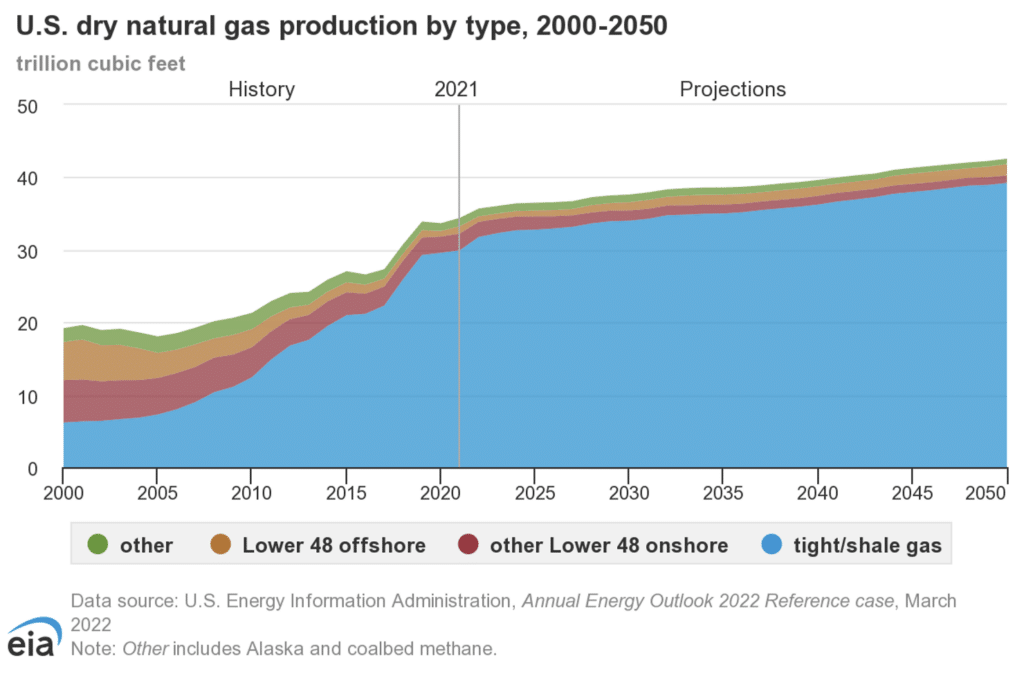
Although Renewable Natural Gas (RNG) production is increasing quickly as we noted in our article Gas Treating Solutions for Renewable Natural Gas, the vast majority of natural gas production in the U.S. is sourced from oil and gas wells, otherwise known as geologic natural gas. The Argonne National Laboratory estimated total RNG production capacity in the U.S. at 3% of total natural gas consumption in America. That means geologic natural gas will continue play the most essential role in meeting future energy demand.

The chart below illustrates where geologic natural gas production is sourced from. Production from shale natural gas resource plays is driving the increase.

EIA chart - Natural gas Projection by Type

Why Does Sour Gas Need to be Treated?

The composition of geologic natural gas production varies widely between different regions in the United States. “Dry” natural gas produced from the Marcellus shale in the Northeast consists almost entirely of methane with very little contaminants and can be produced directly into commercial pipelines with very little or no treating.

In contrast, associated gas produced from the Permian Basin in West Texas and southeastern New Mexico and the Eagle Ford trend in southern Texas generally contains high levels of hydrogen sulfide (H2S) and CO2, making it “sour.”

Because H2S presents a significant threat to infrastructure integrity, most pipelines have stringent limits on H2S concentration that require producers to treat sour gas to remove or destroy the H2S. We provide more detail on natural gas pipeline gas specifications in our article Gas Treating – Processing Solutions for Multiple Industries.

Sour gas assets, typically located in established oil and gas producing regions equipped with infrastructure connecting them to national markets, have a critical role to play in meeting the nation’s energy needs and providing energy security. Gas treating solutions are required to unlock the value of these sour gas resources and sell the energy commercially into a pipeline.

Traditional Gas Treating Methods for Oil & Gas

In our article, Gas Sweetening, Sour Gas Treatment Strategies by Volume, we identified three primary categories of gas treating to remove H2S produced from oil and gas wells:

  • Scavengers and Adsorbents
  • Catalytic reactions
  • Mechanical destruction or Injection

These conventional H2S treatment methods are plagued with numerous downsides, including:

  • Create negative downstream processing effects
  • Require the use of chemicals that can be expensive and present a safety risk
  • Require the disposal of contaminated media, creating environmental and safety risks
  • Operational complexity, requiring frequent oversight on location and problem solving

Gas Treating Innovation – Liquid Redox

An innovative, proven solution for H2S gas treating is the current generation of  Liquid Redox. Liquid Redox has been around a while with mixed success.  The Streamline Valkyrie® Liquid Redox  (Reduction-Oxidation), with upgraded chemistry and automation, converts H2S into benign byproducts including elemental sulfur using chemistry (Reduction) that can be regenerated and be used again by exposure to oxygen (Oxidation).

The gas (i.e., Methane, CO2, other process gases) or air containing the H2S exits the system sweet (without H2S) and the elemental sulfur is filtered from the regenerated chemistry where the chemistry is recirculated to perform the reaction again and the sulfur is collected in a container available for reuse or disposal.

Our VALKYRIE H2S removal system uses this cost-efficient Redox (Reduction-Oxidation) process to help oil and gas operators unlock the value of sour gas resources.

The VALKYRIE system utilizes TALON® chemistry, our non-toxic, biodegradable Redox chemistry. In combination with our advanced automation and control technology, we have created “The Next Generation Redox” system.

Benefits of the VALKRYIE gas treating system:

  • A green solution that converts H2S into benign substances including water and elemental sulfur
  • Universal application for biogas, landfill gas and oil and gas production
  • Widest operating envelope of any H2S Treating method extending across the full spectrum of pressures, flow rates and H2S concentrations
  • Treating to established specifications for sales pipelines, gas lift and fuel gas
  • Flexibility of placement along the production stream whether at the anaerobic digester, at a landfill, wellhead, refinery, in a direct or tail gas treating configuration
  • We specialize in meeting the most stringent outlet specifications.

VALKYRIE gas treating units have been operating reliably for oil and gas producers in the Permian Basin and elsewhere, including Chevron Corporation and Franklin Mountain Energy among others.

Citations

EIA: Natural gas explained, Where our natural gas comes from

EIA: Annual Energy Outlook 2022

University of Texas Interstate Natural Gas – Quality Specifications & Interchangeability