
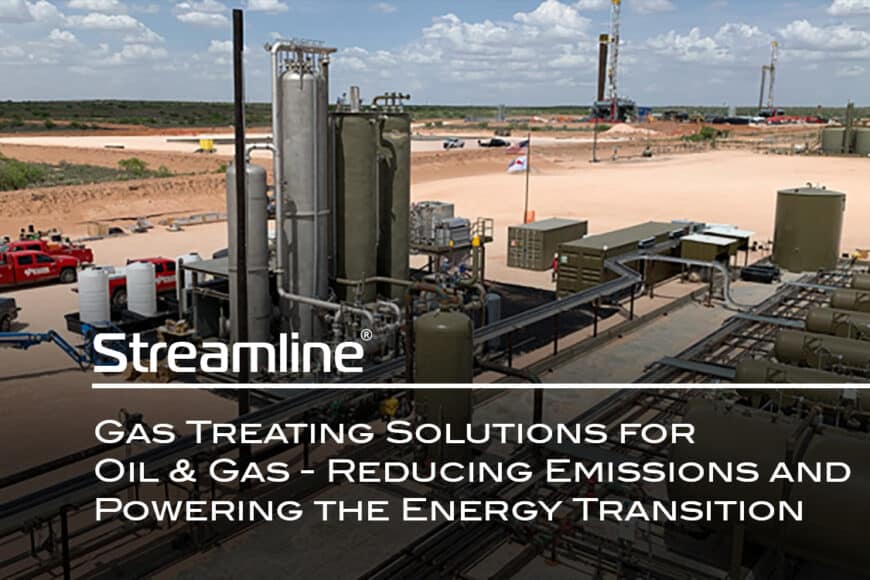
Gas Treating Solutions for Oil & Gas – Reducing Emissions and Powering the Energy Transition
The Role of Natural Gas
The move towards a decarbonized global energy system, otherwise known as the Energy Transition, is underway. In response to the concerns of key stakeholders, including the institutional investment community and regulators, energy companies are adopting initiatives to reduce emissions of Greenhouse Gasses, methane and other substances.
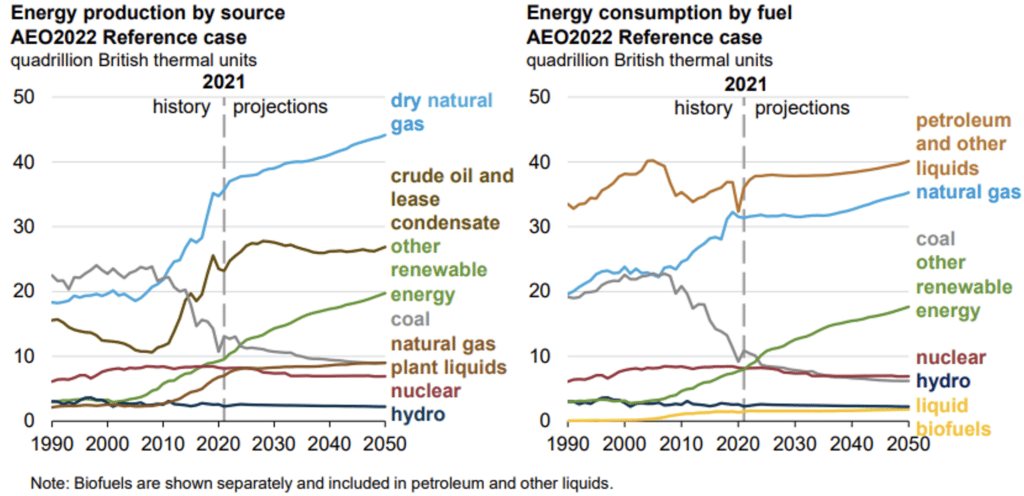
An important part of the Energy Transition is increasing the use of renewable energy sources, typically wind and solar, which emit zero emissions. Although renewable sources today make up less than 10% of total energy consumption in the United States, their share of the overall energy supply is rising rapidly.
Variability, however, is a critical factor hindering the widespread deployment of renewable energy sources. Because wind turbines don’t turn in calm conditions and solar panels have seasonality, can be substantially compromised on cloudy days, and do not provide power at night, these sources are not enough for long-term sustainability and reliability of the grid.
Battery storage has emerged as one solution for solving the problem of variability in renewable electricity production. Numerous battery storage projects are underway to provide long-term storage of electricity generated by renewables during ideal conditions (e.g., a bright sunny day for solar panels), so it can be supplied to the grid during peak demand.
Even considering battery storage, the U.S. Energy Information Agency (EIA) forecasts that renewable energy will provide only 20% of total energy supply by 2050. Meaning, the Energy Transition, if it is to be successful, cannot rely completely on renewable energy.
Increasing Gas Consumption Driving Emissions Lower
Coal-fired power plants are major emitters of Greenhouse Gasses (GHG), primarily CO2. As a result, coal-fired plants are being phased out and being replaced by natural gas fired plants. Coal-to-gas switching is a major factor driving GHG emissions lower in the U.S.

EIA reports that emissions of CO2 have declined substantially, primarily because of power plants switching to natural gas away from coal fired power plants. Further, EIA expects adoption of natural gas for power generation to increase through 2050 as it displaces coal as a primary feedstock.
Whether natural gas is produced from geologic sources or captured from biogas operations or landfills, it burns cleaner than coal, making gas a vital component of a successful Energy Transition. But where will it come from?
The Howling Wolfcamp in the Permian Basin!
As we noted in our article Gas Treating – Processing Solutions for Multiple Industries, natural gas is expected to play a foundational role in meeting future energy consumption. In fact, the U.S. Energy Information Agency (EIA) forecasts that U.S. natural gas consumption will grow by almost 25% through 2050 and maintain the second-largest market share overall.
In the EIA’s March 2022 update, the agency provided further detail on where the growth in geologic natural gas supply is expected to come from:
- More than half of the growth in U.S. natural gas production will be sourced from oil formations, known as associated gas.
- The largest increase in production of associated gas is in the Wolfcamp tight oil shale formation of the Permian Basin in the U.S. Southwest.
- The proximity of the Permian Basin in general, and the Wolfcamp formation more specifically, to LNG export terminals on the U.S. Gulf Coast in Texas and Louisiana has encouraged production growth in this region.
The Permian Basin itself is the most active oil drilling region in the U.S. As of January 27, 2023, the Baker Hughes Rig Count reported 357 rigs were working in the Permian Basin, nearly half of all working rigs in the U.S. The reason is simple – the Permian is a prolific world-class oil and gas resource.
Demand for U.S. gas exports, namely liquefied natural gas (LNG), to Europe and other developed regions lacking local energy resources, is an important driver of natural gas production growth from the Permian, including the Wolfcamp and other formations in the Permian Basin. The nearby Eagle Ford Shale contributes significantly to the availability of gas for LNG exports.
The Sour Gas Treating Challenge
One of the challenges for oil and gas operators in the Permian Basin is gas treating for hydrogen sulfide (H2S). Much of the associated gas produced from the Permian Basin in West Texas and southeastern New Mexico and the Eagle Ford trend in southern Texas generally contains high levels of H2S, making it “sour.”
Since H2S presents a significant threat to infrastructure integrity, most pipelines have stringent limits for H2S concentration that require producers to treat sour gas to remove or destroy it. We provide more detail on natural gas pipeline gas specifications in our article Gas Treating – Processing Solutions for Multiple Industries.
Sour gas assets, typically located in established oil and gas producing regions equipped with infrastructure connecting them to national and international markets, have a critical role to play in meeting the nation’s energy needs and providing energy security. Gas treating solutions are required to unlock the value of these sour gas resources so they can be transported via pipeline, instead of burned or flared, which produces harmful sulfur dioxide (SO2).
In our article, Gas Sweetening, Sour Gas Treatment Strategies by Volume, we identified the three primary categories of traditional gas treating methods for removing H2S from associated gas, but they have numerous downsides, including:
- Create negative downstream processing effects.
- Require the use of chemicals that can be expensive and present a safety risk.
- Require the disposal of contaminated media, creating environmental and safety risks.
- Operational complexity, requiring frequent oversight on location and problem solving.
A Gas Treating Innovation – Liquid Redox
There is a proven, green solution for H2S gas treating not plagued by the downsides of traditional methods – Liquid Redox. The first generation of Liquid Redox enjoyed some mixed success treating H2S, but it was not reliable enough for large-scale applications. The next generation of Liquid-Redox gas treating for H2S, however, is a different story.
VALKRYIE® Liquid Redox (Reduction-Oxidation) technology from Streamline Innovations is based on new, updated chemistry and state-of-the-art process automation to reliably convert H2S into benign byproducts including elemental sulfur using chemistry (Reduction) that can be regenerated and be used again by exposure to oxygen (Oxidation).
The gas (i.e., Methane, CO2, other process gases) or air containing the H2S exits the system sweet (i.e., without H2S) and the elemental sulfur is filtered from the regenerated chemistry. The chemistry is then recirculated to perform the reaction again and the sulfur is collected in a container available for use or disposal.
The Streamline VALKYRIE H2S removal system is the next generation of Liquid Redox (Reduction-Oxidation) to cost-efficiently help oil and gas operators unlock the value of sour gas resources.
The VALKYRIE system utilizes TALON® chemistry, our non-toxic, biodegradable Redox chemistry. In combination with our advanced automation and control technology, Streamline has created “The Next Generation Redox” system.
Benefits of the VALKRYIE gas treating system:
- A green solution that converts H2S into benign substances including water and elemental sulfur.
- Universal application for biogas, landfill gas and oil and gas production.
- Widest operating envelope of any H2S gas treating method extending across the full spectrum of pressures, flow rates and H2S concentrations.
- Treating to established specifications for sales pipelines, gas lift and fuel gas.
- Flexibility of placement along the production stream whether at the anaerobic digester, at a landfill, wellhead, refinery, in a direct or tail gas treating configuration.
- Meets the most stringent outlet specifications.
VALKYRIE gas treating units have been operating reliably for oil and gas producers in the Permian Basin and elsewhere, including Chevron Corporation and Franklin Mountain Energy among others.
Citations
EIA: Natural gas explained, Where our natural gas comes from
EIA expects U.S. natural gas production to rise as demand for exports grow
EIA: Annual Energy Outlook 2022
University of Texas Interstate Natural Gas – Quality Specifications & Interchangeability