

The Role of Natural Gas
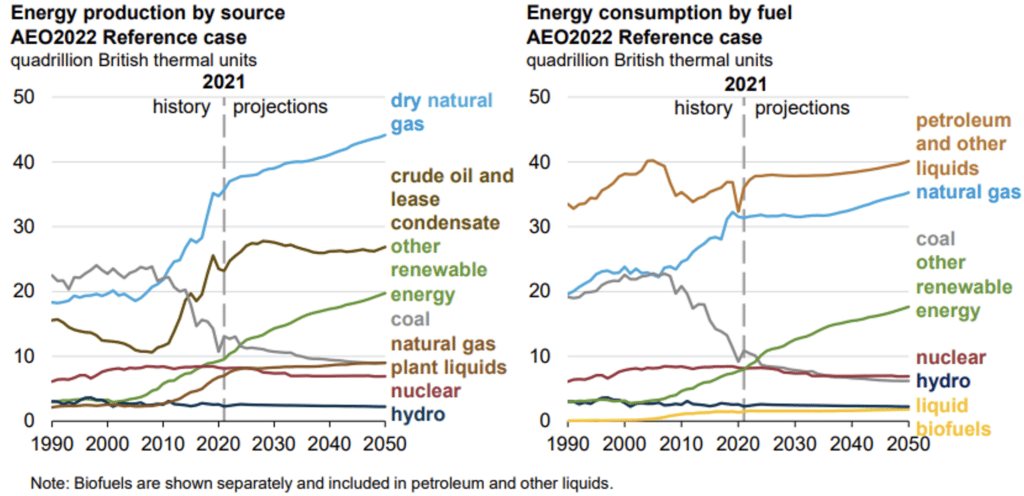
As we noted in our blog article Gas Treating – Processing Solutions for Multiple Industries, natural gas is expected to play a critical role in fulfilling future energy needs. The U.S. Energy Information Agency (EIA) forecasts that natural gas consumption will keep growing through 2050, maintaining the second-largest market share overall.
Coal-to-Gas Switching Driving Emissions Reduction
One of the major factors driving the forecasted increase in natural gas consumption is coal-to-gas switching. As coal-fired power plants are phased out, natural gas fired plants are picking up the slack.

EIA reports that emissions of CO2, a primary Greenhouse Gas (GHG) have declined substantially, primarily because of power generation switching to natural gas away from coal fired power plants. Further, EIA expects adoption of natural gas for power generation to increase through 2050 as it displaces coal as a primary feedstock.
Geologic Natural Gas Still Dominant
Although Renewable Natural Gas (RNG) production is increasing quickly as we noted in our article Gas Treating Solutions for Renewable Natural Gas, the vast majority of natural gas production in the U.S. is sourced from oil and gas wells, otherwise known as geologic natural gas. The Argonne National Laboratory estimated total RNG production capacity in the U.S. at 3% of total natural gas consumption in America. That means geologic natural gas will continue play the most essential role in meeting future energy demand.
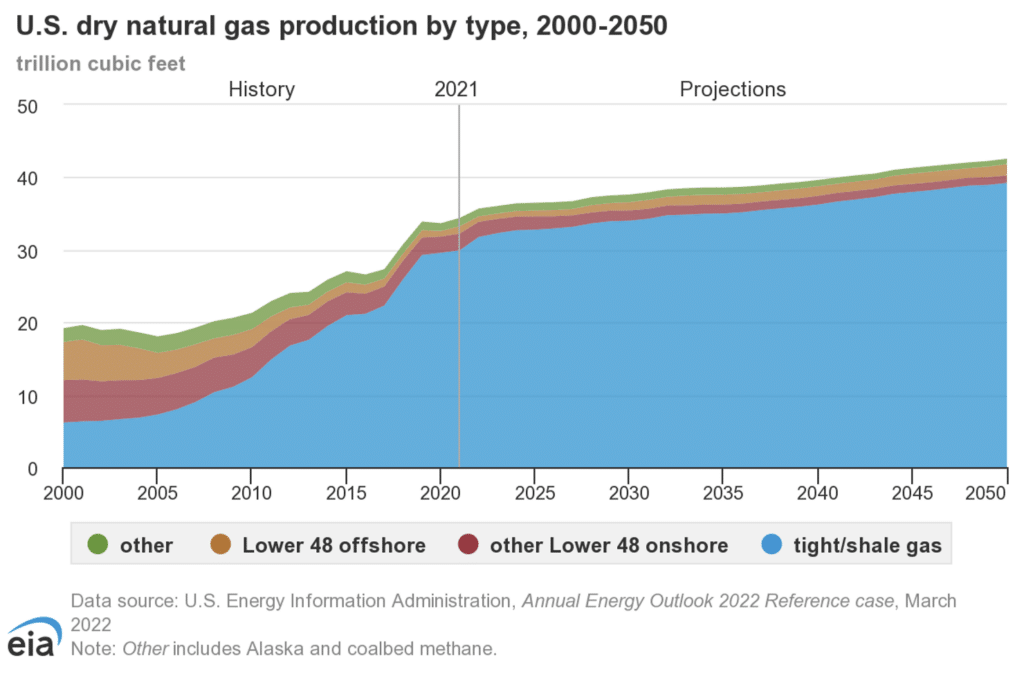
The chart below illustrates where geologic natural gas production is sourced from. Production from shale natural gas resource plays is driving the increase.
Why Does Sour Gas Need to be Treated?
The composition of geologic natural gas production varies widely between different regions in the United States. “Dry” natural gas produced from the Marcellus shale in the Northeast consists almost entirely of methane with very little contaminants and can be produced directly into commercial pipelines with very little or no treating.
In contrast, associated gas produced from the Permian Basin in West Texas and southeastern New Mexico and the Eagle Ford trend in southern Texas generally contains high levels of hydrogen sulfide (H2S) and CO2, making it “sour.”
Because H2S presents a significant threat to infrastructure integrity, most pipelines have stringent limits on H2S concentration that require producers to treat sour gas to remove or destroy the H2S. We provide more detail on natural gas pipeline gas specifications in our article Gas Treating – Processing Solutions for Multiple Industries.
Sour gas assets, typically located in established oil and gas producing regions equipped with infrastructure connecting them to national markets, have a critical role to play in meeting the nation’s energy needs and providing energy security. Gas treating solutions are required to unlock the value of these sour gas resources and sell the energy commercially into a pipeline.
Traditional Gas Treating Methods for Oil & Gas
In our article, Gas Sweetening, Sour Gas Treatment Strategies by Volume, we identified three primary categories of gas treating to remove H2S produced from oil and gas wells:
- Scavengers and Adsorbents
- Catalytic reactions
- Mechanical destruction or Injection
These conventional H2S treatment methods are plagued with numerous downsides, including:
- Create negative downstream processing effects
- Require the use of chemicals that can be expensive and present a safety risk
- Require the disposal of contaminated media, creating environmental and safety risks
- Operational complexity, requiring frequent oversight on location and problem solving
Gas Treating Innovation – Liquid Redox
An innovative, proven solution for H2S gas treating is the current generation of Liquid Redox. Liquid Redox has been around a while with mixed success. The Streamline Valkyrie® Liquid Redox (Reduction-Oxidation), with upgraded chemistry and automation, converts H2S into benign byproducts including elemental sulfur using chemistry (Reduction) that can be regenerated and be used again by exposure to oxygen (Oxidation).
The gas (i.e., Methane, CO2, other process gases) or air containing the H2S exits the system sweet (without H2S) and the elemental sulfur is filtered from the regenerated chemistry where the chemistry is recirculated to perform the reaction again and the sulfur is collected in a container available for reuse or disposal.
Our VALKYRIE H2S removal system uses this cost-efficient Redox (Reduction-Oxidation) process to help oil and gas operators unlock the value of sour gas resources.
The VALKYRIE system utilizes TALON® chemistry, our non-toxic, biodegradable Redox chemistry. In combination with our advanced automation and control technology, we have created “The Next Generation Redox” system.
Benefits of the VALKRYIE gas treating system:
- A green solution that converts H2S into benign substances including water and elemental sulfur
- Universal application for biogas, landfill gas and oil and gas production
- Widest operating envelope of any H2S Treating method extending across the full spectrum of pressures, flow rates and H2S concentrations
- Treating to established specifications for sales pipelines, gas lift and fuel gas
- Flexibility of placement along the production stream whether at the anaerobic digester, at a landfill, wellhead, refinery, in a direct or tail gas treating configuration
- We specialize in meeting the most stringent outlet specifications.
VALKYRIE gas treating units have been operating reliably for oil and gas producers in the Permian Basin and elsewhere, including Chevron Corporation and Franklin Mountain Energy among others.
Citations
EIA: Natural gas explained, Where our natural gas comes from
EIA: Annual Energy Outlook 2022
University of Texas Interstate Natural Gas – Quality Specifications & Interchangeability