
Loading
Making heavy industry cleaner, sustainable, more profitable.
  • VALKYRIE® next generation liquid redox technology is a green hydrogen sulfide (H2S) removal technology to help upgrade biogas and Landfill Gas to Renewable Natural Gas (RNG).
  • VALKYRIE H2S treatment converts hydrogen sulfide into elemental sulfur, OMRI-certified for use in organic food production.
  • VALKYRIE ECO is targeted to the agricultural biogas market and the VALKYRIE ECO FLEX is ideal for Landfill Gas applications.

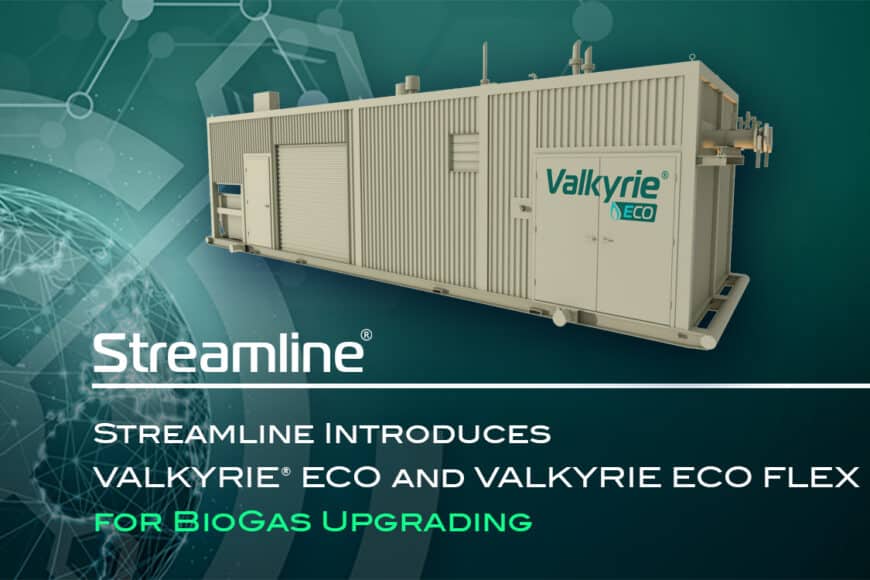
SAN ANTONIO, TEXAS, MAY 15, 2023 – Streamline Innovations, Inc. (“Streamline”) announced the introduction of the VALKYRIE® ECO and VALKYRIE ECO FLEX H2S treating solutions configured specifically for agricultural biogas and Landfill Gas (LFG) operations.

The VALKYRIE ECO model is designed for agricultural biogas applications and the VALKYRIE ECO FLEX solution is engineered for larger volume operations, such as landfills. Both units utilize TALON®, a non-toxic and biodegradable Redox chemistry to remove H2S in an environmentally responsible way.

Streamline’s products are manufactured and assembled in the USA.

The enclosed, skid-mounted VALKYRIE ECO unit is ideal for H2S removal as part of the biogas-to-RNG upgrading process.

David Sisk, Streamline’s Chief Executive Officer said, “The introduction of the VALKYRIE ECO and ECO FLEX solutions comes right as the Biogas-to-RNG market is rapidly gaining momentum. RNG project developers need a reliable, proven and environmentally sustainable solution for purifying biogas of hydrogen sulfide in the RNG upgrading process so they can sell it into commercial pipelines. VALKYRIE H2S treating technology has been working successfully for years in Oil & Gas and other industries, and its application to the RNG market is a natural extension of this innovative yet proven approach.”

Legacy methods for treating H2S have notable downsides, including handling and disposal of hazardous spent media as well as excessive downtime while biological treatment colonies repopulate. Streamline Innovation’s robust Next Generation Liquid Redox process converts H2S into elemental sulfur and water vapor. The Simple Elemental Sulfur™ byproduct is approved by the Organic Materials Review Institute (OMRI) for use in organic food production.

Both the VALKYRIE ECO and VALKYRIE ECO FLEX are designed to work effectively in the lower gas pressure environments typically found in biogas and Landfill Gas applications. Importantly, the VALKYRIE ECO FLEX model uses a modular design that allows customers to scale treating capacity in increments to meet individual LFG gas stream volumes.  

Biogas contaminated with H2S flows through the VALKYRIE H2S treating units containing specialized TALON catalyst, and then exits free of H2S, ready for additional treating to remove other contaminants such as oxygen, carbon dioxide and siloxanes, among others. The VALKYRIE ECO and VALKYRIE ECO FLEX are designed to remove H2S to levels that meet commercial pipeline specifications without additional polishing.

Visit the VALKYRIE Biogas-to-RNG web page for more information on Streamline’s green solutions for H2S treating.

About Streamline Innovations

Streamline Innovations’ vision is Eliminating Emissions Through Technology. We help heavy industry around the world achieve environmental performance objectives, improve sustainability, and transition to a sustainable, low-carbon economy.

Streamline’s environmentally forward H2S treating solutions help our customers achieve the “E” in ESG. H2S is present in many industrial processes throughout the world, and our technology can be applied across industries, delivering a sustainable solution that eliminates H2S, a leading cause of human inhalation accidents, corrosion and SO2 emissions, a primary cause of acid rain.

We also believe that achieving climate-improving directives requires data. Creating intelligent systems that operate effectively and efficiently without human intervention is critical to measuring and reducing emissions that harm the environment. We integrate advanced process control, data collection and analytics in our technologies to provide a total solution for customers.

We serve organizations in multiple sectors, including Energy/Oil & Gas, Biogas, Landfill Gas & Renewable Fuels, Municipal Wastewater and Industrial Air & Water.

Contacts

General Inquiries:
Randy Rohlfs
Chief Commercial Officer
Streamline Innovations, Inc.
Randy.Rohlfs@StreamlineInnovations.com

Sales Inquiries:
Jacob Pratt
SVP – Sales
Jacob.Pratt@StreamlineInnovations.com

SAN ANTONIO, TX (May 9, 2023) – Streamline Innovations will be participating in the Biogas Americas 2023 conference, hosted by the American Biogas Council in Chicago, IL on May 15-18 at the Sheraton Grand Hotel.

VALKYRIE H2S treating technology from Streamline Innovations provides RNG project developers and operators a reliable, proven and environmentally sustainable solution for purifying biogas feedstocks of hydrogen sulfide in the RNG upgrading process so they can sell it to commercial pipelines.

Our VALKYRIE® H2S treating solutions use TALON® chemistry, a non-toxic and biodegradable Redox substance to remove H2S in an environmentally responsible way. The Simple Elemental Sulfur™ byproduct is approved by Organic Materials Review Institute (OMRI) for use in organic food production.

Representatives from Streamline Innovations will be at the conference, and interested parties are encouraged to schedule a meeting while at the conference.

Biogas Americas 2023 describes itself as the largest biogas conference and tradeshow in North America and is the annual conference of the American Biogas Council (ABC). ABC is the voice of the U.S. biogas industry dedicated to maximizing carbon reduction and economic growth using biogas systems. Whether you are a project developer, equipment supplier, service provider, operator, investor, utility, policymaker, or anyone whose success depends on the growth and profitability of biogas as a resource, there is no better way to build your business and stay informed of the latest developments in the industry.

Contact

Jacob Pratt
Senior Vice President – Sales
Streamline Innovations, Inc.
Jacob.Pratt@streamlineinnovations.com

About Streamline Innovations

Streamline Innovation’s vision is Eliminating Emissions Through Technology.  We help heavy industry around the world achieve environmental performance objectives, improve sustainability, and transition to a sustainable, low-carbon economy.

H2S is present in almost every industrial process in the world.  Our technology can be applied across industries, delivering a sustainable solution that eliminates H2S, the leading cause of acid rain, a deadly greenhouse gases dangerous for work and living environments.

Streamline believes that achieving the E (“Environmental”) in ESG requires data. Creating intelligent systems that operate effectively and efficiently without human intervention is critical to reducing emissions that harm the environment.   We integrate advanced data collection, process control, and analytics in our technologies to provide a total solution for customers.

We serve organizations in multiple sectors, including Energy/Oil & Gas, Biogas, Landfill Gas & Renewable Fuels, Municipal Wastewater and Industrial Air & Water.

The world’s population continues to grow, driving future energy demand higher. In addition, as more societies across the globe become more prosperous, they tend to adopt a more energy-intensive lifestyle. As we noted in our blog article, Gas Treating Solutions for Renewable Natural Gas, a growing human population is anticipated to have an increasingly significant impact on the generation of emissions associated with climate change:

The World Bank forecasts solid waste will increase nearly 70% by 2050, as the world population grows. Landfills are significant sources of methane emissions. An article in Science Advances describes using satellite imagery and analysis to estimate that landfills are the third largest source of methane emissions globally, trailing oil & gas systems and agriculture.

Capturing the methane produced by landfills and agricultural operations and using it as an energy source represents a unique opportunity to both meet future energy needs while reducing the impact of emissions.

Against this backdrop, Renewable Natural Gas (RNG) is expected to play an important role in providing affordable and reliable energy to a growing global population.

The H2S Treating Imperative for Biogas-to-RNG Upgrading

The U.S. Environmental Protection Agency (EPA) defines RNG as “…anaerobically-generated biogas that has been upgraded (or refined) for use in place of fossil natural gas. Raw biogas typically has a CH4 content between 45 and 65 percent, depending on the source of the biogas, and must go through a series of steps to be converted into RNG.”

Commercial pipelines typically require natural gas to have methane (CH4) content ranging between 85% to 95%, with the remainder typically consisting of Natural Gas Liquids (NGLs), such as ethane, butane, and other substances. Some pipelines are more stringent than others.

Since raw biogas typically has methane content between 45-60%, it must be upgraded to meet pipeline quality specifications. This biogas-to-RNG upgrading process involves removing a myriad of contaminants, including hydrogen sulfide (H2S), water, oxygen, carbon dioxide, siloxanes, and other substances.

H2S is one of the most common contaminants of biogas sourced from Anaerobic Digesters and Landfills. It is highly corrosive to metal pipelines, valves, and other equipment, making it an imperative to keep H2S out of the natural gas distribution system to avoid the risk of a catastrophic failure.

Commercial Pipeline Specifications for H2S

The U.S. Energy Information Agency (EIA) reports that there are approximately 210 natural gas pipeline systems with approximately 3 million miles of mainline and other gas pipelines in the nation’s pipeline infrastructure linking producers with consumers.

Each of these pipelines has specification for natural gas, mandating ranges for gas composition, including levels of H2S.

Sources providing insight into H2S levels for pipeline quality gas include:

  • Penn State University lists typical natural gas composition specifications in its Petroleum Processing course, and notes in its Specifications for Pipeline Quality Gas the amount of H2S must be at “trace levels” ranging between 0.25 and 0.3 grains per 100 standard cubic feet.
  • As previously noted in our article Gas Treating – Processing Solutions for Multiple Industries, the University of Texas found that the interstate pipeline specifications for H2S range between 0.25 grains per 100 standard cubic feet to 1.0 grains.
  • Pacific Gas & Electric specifies that for its pipeline system, natural gas from California gas wells and received from out of state sources “…shall contain no more than 0.25 grain (4 ppm) of hydrogen sulfide per one hundred standard cubic feet.”

Biogas and Landfill Gas operators need a flexible, sustainable, and cost effective method for removing H2S for upgrading their gas feedstocks to valuable RNG.

Liquid Redox Solution for Removing H2S in Biogas-to-RNG Upgrading

The VALKYRIE® H2S removal system from Streamline Innovations utilizes a Liquid Redox process for converting H2S into elemental sulfur and water vapor. VALKYRIE next generation Liquid Redox employs TALON® chemistry, our non-toxic, biodegradable chemistry to remove H2S and convert it into elemental sulfur (Reduction) and then regenerated and used again by exposure to oxygen (Oxidation).

Benefits of the VALKRYIE gas treating system:

  • A green solution that converts H2S into benign substances including water and elemental sulfur
  • Universal application for biogas, landfill gas and oil and gas production
  • Widest operating envelope of any H2S Treating method extending across the full spectrum of pressures, flow rates and H22S concentrations
  • Treating to established specifications for sales pipelines, gas lift and fuel gas
  • Flexibility of placement along the production stream whether at the anaerobic digester, at a landfill, wellhead, refinery, in a direct or tail gas treating configuration
  • High turndown
  • Specialize in meeting the most stringent outlet specifications
  • Made in the USA

VALKYRIE H2S treating technology gives biogas and landfill gas producers a smart, economical and sustainable method for H2S removal in the Biogas-to-RNG upgrading process.

Contact us today to learn more about Next Generation Liquid Redox H2S treating technology and determine if the VALKYRIE system is right for your operation.


Citations and Resources

U.S. Environmental Protection Agency, An Overview of Renewable Natural Gas from Biogas, July 2020.

PennState University, Natural Gas Composition and Specifications.

U.S. Energy Information Agency, Natural Gas Explained, Natural Gas Pipelines.

U.S. Energy Information Agency, About U.S. Natural Gas Pipelines – Transporting Natural Gas.

Pacific Gas & Electric, California Gas Transmission – Pipeline Ranger – Sulfur.

Treating natural gas streams for hydrogen sulfide (H2S) is a priority for Oil & Gas producers worldwide. In the United States, much of the associated gas produced from the strategically important producing regions in the Permian Basin and the Eagle Ford trend in southern Texas contains high levels of H2S, making it “sour.”

These oil and gas producing regions are served by established infrastructure and the sour gas assets there play an important role in meeting the nation’s current and future energy needs.

But there is a problem with sour gas. Because H2S is highly corrosive to infrastructure and presents a threat to human health, most pipelines have established strict limits on H2S concentration requiring Oil & Gas operators to remove or otherwise destroy it. In our article Gas Treating – Processing Solutions for Multiple Industries, we reported that The University of Texas found that the interstate pipeline specifications for H2S range between 0.25 grains per 100 cubic feet to 1.0 grain.

Although flaring or combusting associated gas contaminated with H2S is one way to dispose of it, the practice produces harmful sulfur dioxide (SO2), which is a major contributor to acid rain and regulated by the Clean Air Act. Alternatives to flaring are to capture or destroy the H2S using chemical, biological, or mechanical processes that have different trade offs in terms of capital and operation expenses, and have significantly different waste streams. 

In this article we compare the two most common H2S Treatment strategies used by oil producers for treating H2S in the field: Scavenger and Next-Generation Liquid Redox.

H2S Scavengers

Using an H2S scavenger to treat sour gas is a common legacy method for “sweetening” sour gas by removing H2S from natural gas streams using a chemical reaction. A scavenger tower brings sour gas into contact with liquid or solid media, which captures the H2S.

Triazine is commonly used to treat H2S in natural gas streams. It is a clear to pale yellow liquid with a fishy smell. Because triazine cannot be used at full strength, it is usually mixed with other substances to bring the concentration down to field strengths ranging from 20-80%, depending on the application.

Triazine can be injected directly into gas streams or used in a contact tower (scavenger). H2S scavengers using contact towers are considered up to 80% efficient, as compared to only 40% efficiency for direct injection.

Triazine works by binding itself to the H2S molecule. The reaction is defined as one mole of triazine reacting with two moles of H2S to form dithiazine. This is a one-time, non-reversible chemical reaction.

In a liquid H2S scavenger using triazine, produced gas is fed into a tower vessel where it bubbles up through the liquid. As the H2S contacts the triazine in the treating tower, it is rendered harmless.

Because triazine scavenging is a non-regenerative process, triazine must be replaced periodically and the spent liquid must be disposed of.

Triazine H2S Treating Pros and Cons

The benefits of using triazine for treating H2S in gas streams include:

  • Minimal installation cost.
  • Can be cost effective, depending on gas flow rate.
  • Zero air emissions.
  • Widely available in most oil and gas producing regions.
  • Skid-based units can be mobilized from one location to another quickly and easily.

Downsides include:

  • Contact towers are typically only 80% efficient, direct injection only ~40% efficient.
  • Disposal of spent triazine can be problematic in some areas.
  • Non-regenerative process, meaning frequent media changes.
  • Often requires use of other chemicals to mitigate negative downstream effects.
  • Contact towers (bubble towers) can be operationally complex and require frequent attention.
  • Can be costly when treating gas with high concentrations of H2S and/or high gas flow rates.
  • Worker exposure to chemicals at the worksite, potential health and safety concerns.

Next Generation Liquid Redox for H2S Treating

The Liquid Redox (Reduction-Oxidation) process converts H2S into elemental sulfur and water vapor byproducts using chemistry (Reduction) that can be regenerated and used again with exposure to air (Oxidation).

Using a Next Generation Liquid Redox process, sour gas is directed into a treating vessel containing specialized chemistry and then exits the system sweet (without H2S) into a gas sales line. The elemental sulfur byproduct is filtered out of the liquid, and the chemistry is then regenerated with exposure to oxygen. The regenerated chemistry is then recirculated back into the treating vessel to perform the reaction again. The regenerative nature of the chemistry reduces media changes, disposal costs and reduces chemical handling requirements on the well site.

The VALKYRIE® H2S treating solution from Streamline Innovations utilizes relatively recent technological advances in automation control to create the “Next Generation Redox” system. The VALKYRIE system utilizes TALON® chemistry, our non-toxic, biodegradable Redox chemistry.

Focus on Triazine Disposal

As previously noted, there are several downsides to H2S scavengers using liquid triazine. Because the triazine-H2S reaction is non-regenerative, the spent chemical must be replaced periodically and disposed of.

Dithiazine is the byproduct of using triazine to remove H2S from oil and gas streams and has no secondary use. It is a liquid waste product that requires proper disposal, in saltwater disposal (SWD) wells along with produced water, if the SWD operator allows, or at a hazardous materials disposal facility.

Comparison – Triazine H2S Scavengers vs. Next Generation Redox

We compare H2S scavengers using liquid triazine with the latest generation of Liquid Redox.

Spent Media Disposal. Because treating H2S using liquid triazine or solid media involve one-time, non-regenerative chemical reactions, the spent triazine must be replenished and the liquid byproduct disposed of properly. Solid media must also be periodically changed and disposed of at a hazardous materials landfill. Frequency of chemical and media changeouts is a function of several factors, including gas flow rates, H2S concentration, scavenger vessel size and other variables.

Chemical Handling and Safety. Liquid triazine is typically transported in plastic totes and delivered to the well site or production pad. Field personnel can be exposed to triazine when moving totes around the well site, installing H2S scavenger equipment and maintaining contact towers and injection equipment.

Exposure to triazine can cause skin rashes, eye irritation and the U.S. Environmental Protection Agency considers triazines as possible human carcinogens.

Operating Cost. Triazine H2S scavengers are often more expensive than Next Generation Liquid Redox, especially for high levels of H2S, because spent triazine must be replaced more frequently and can become overwhelmed at high concentrations, while TALON chemistry is regenerated, reducing the frequency of chemistry changes and chemical handling.  

A Clear Advantage

The VALKYRIE Next Generation Liquid Redox system is the clear winner for treating high H2S sour gas when all the risks and costs are taken into account.

Benefits of the VALKRYIE gas treating system:

  • A green solution that converts H2S into the benign substances of water vapor and elemental sulfur.
  • Universal application for biogas, landfill gas, and oil and gas production.
  • Widest operating envelope of any H2S Treating method extending across the full spectrum of pressures, flow rates and H2S concentrations.
  • Treating to established specifications for sales pipelines, gas lift and fuel gas conditioning.
  • Flexibility of placement along the production stream whether at the anaerobic digester, at a landfill, wellhead, refinery, in a direct or tail gas treating configuration.
  • Easily adjusted for variation in gas flow and H2S concentrations.

We specialize in meeting the most stringent outlet specifications.

Contact us today to learn more about Next Generation Liquid Redox H2S treating technology and determine if the VALKYRIE system is right for your operation.

The Role of Natural Gas

The move towards a decarbonized global energy system, otherwise known as the Energy Transition, is underway. In response to the concerns of key stakeholders, including the institutional investment community and regulators, energy companies are adopting initiatives to reduce emissions of Greenhouse Gasses, methane and other substances.

An important part of the Energy Transition is increasing the use of renewable energy sources, typically wind and solar, which emit zero emissions. Although renewable sources today make up less than 10% of total energy consumption in the United States, their share of the overall energy supply is rising rapidly.

Variability, however, is a critical factor hindering the widespread deployment of renewable energy sources. Because wind turbines don’t turn in calm conditions and solar panels have seasonality, can be substantially compromised on cloudy days, and do not provide power at night, these sources are not enough for long-term sustainability and reliability of the grid.

Battery storage has emerged as one solution for solving the problem of variability in renewable electricity production. Numerous battery storage projects are underway to provide long-term storage of electricity generated by renewables during ideal conditions (e.g., a bright sunny day for solar panels), so it can be supplied to the grid during peak demand.

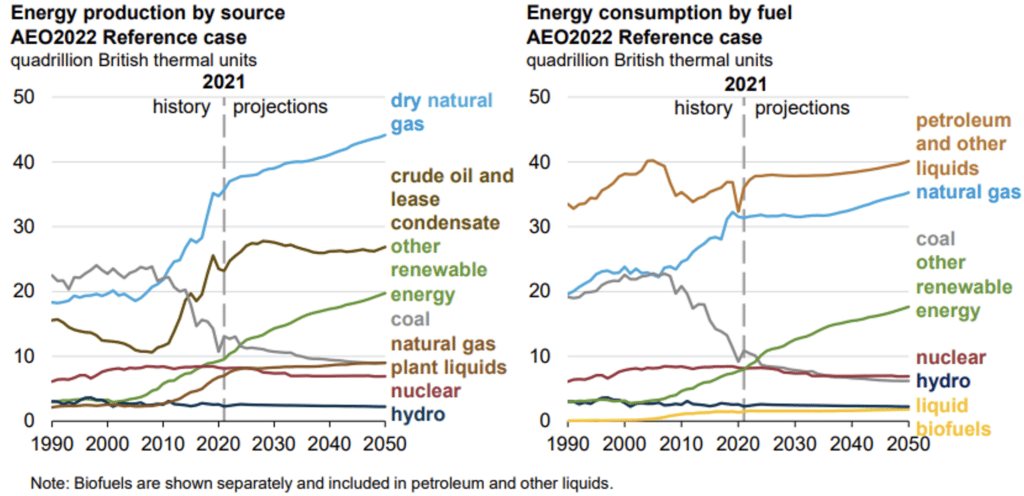
Even considering battery storage, the U.S. Energy Information Agency (EIA) forecasts that renewable energy will provide only 20% of total energy supply by 2050. Meaning, the Energy Transition, if it is to be successful, cannot rely completely on renewable energy.

Increasing Gas Consumption Driving Emissions Lower

Coal-fired power plants are major emitters of Greenhouse Gasses (GHG), primarily CO2. As a result, coal-fired plants are being phased out and being replaced by natural gas fired plants. Coal-to-gas switching is a major factor driving GHG emissions lower in the U.S.

EIA reports that emissions of CO2 have declined substantially, primarily because of power plants switching to natural gas away from coal fired power plants. Further, EIA expects adoption of natural gas for power generation to increase through 2050 as it displaces coal as a primary feedstock.

Whether natural gas is produced from geologic sources or captured from biogas operations or landfills, it burns cleaner than coal, making gas a vital component of a successful Energy Transition. But where will it come from?

The Howling Wolfcamp in the Permian Basin!

As we noted in our article Gas Treating – Processing Solutions for Multiple Industries, natural gas is expected to play a foundational role in meeting future energy consumption. In fact, the U.S. Energy Information Agency (EIA) forecasts that U.S. natural gas consumption will grow by almost 25% through 2050 and maintain the second-largest market share overall.

In the EIA’s March 2022 update, the agency provided further detail on where the growth in geologic natural gas supply is expected to come from:

  • More than half of the growth in U.S. natural gas production will be sourced from oil formations, known as associated gas.
  • The largest increase in production of associated gas is in the Wolfcamp tight oil shale formation of the Permian Basin in the U.S. Southwest.
  • The proximity of the Permian Basin in general, and the Wolfcamp formation more specifically, to LNG export terminals on the U.S. Gulf Coast in Texas and Louisiana has encouraged production growth in this region.

The Permian Basin itself is the most active oil drilling region in the U.S. As of January 27, 2023, the Baker Hughes Rig Count reported 357 rigs were working in the Permian Basin, nearly half of all working rigs in the U.S. The reason is simple – the Permian is a prolific world-class oil and gas resource.

Demand for U.S. gas exports, namely liquefied natural gas (LNG), to Europe and other developed regions lacking local energy resources, is an important driver of natural gas production growth from the Permian, including the Wolfcamp and other formations in the Permian Basin.  The nearby Eagle Ford Shale contributes significantly to the availability of gas for LNG exports.

The Sour Gas Treating Challenge

One of the challenges for oil and gas operators in the Permian Basin is gas treating for hydrogen sulfide (H2S). Much of the associated gas produced from the Permian Basin in West Texas and southeastern New Mexico and the Eagle Ford trend in southern Texas generally contains high levels of H2S, making it “sour.”

Since H2S presents a significant threat to infrastructure integrity, most pipelines have stringent limits for H2S concentration that require producers to treat sour gas to remove or destroy it. We provide more detail on natural gas pipeline gas specifications in our article Gas Treating – Processing Solutions for Multiple Industries.

Sour gas assets, typically located in established oil and gas producing regions equipped with infrastructure connecting them to national and international markets, have a critical role to play in meeting the nation’s energy needs and providing energy security. Gas treating solutions are required to unlock the value of these sour gas resources so they can be transported via pipeline, instead of burned or flared, which produces harmful sulfur dioxide (SO2).

In our article, Gas Sweetening, Sour Gas Treatment Strategies by Volume, we identified the three primary categories of traditional gas treating methods for removing H2S from associated gas, but they have numerous downsides, including:

  • Create negative downstream processing effects.
  • Require the use of chemicals that can be expensive and present a safety risk.
  • Require the disposal of contaminated media, creating environmental and safety risks.
  • Operational complexity, requiring frequent oversight on location and problem solving.

A Gas Treating Innovation – Liquid Redox

There is a proven, green solution for H2S gas treating not plagued by the downsides of traditional methods – Liquid Redox. The first generation of Liquid Redox enjoyed some mixed success treating H2S, but it was not reliable enough for large-scale applications. The next generation of Liquid-Redox gas treating for H2S, however, is a different story.

VALKRYIE® Liquid Redox (Reduction-Oxidation) technology from Streamline Innovations is based on new, updated chemistry and state-of-the-art process automation to reliably convert H2S into benign byproducts including elemental sulfur using chemistry (Reduction) that can be regenerated and be used again by exposure to oxygen (Oxidation).

The gas (i.e., Methane, CO2, other process gases) or air containing the H2S exits the system sweet (i.e., without H2S) and the elemental sulfur is filtered from the regenerated chemistry.  The chemistry is then recirculated to perform the reaction again and the sulfur is collected in a container available for use or disposal.

The Streamline VALKYRIE H2S removal system is the next generation of Liquid Redox (Reduction-Oxidation) to cost-efficiently help oil and gas operators unlock the value of sour gas resources.

The VALKYRIE system utilizes TALON® chemistry, our non-toxic, biodegradable Redox chemistry. In combination with our advanced automation and control technology, Streamline has created “The Next Generation Redox” system.

Benefits of the VALKRYIE gas treating system:

  • A green solution that converts H2S into benign substances including water and elemental sulfur.
  • Universal application for biogas, landfill gas and oil and gas production.
  • Widest operating envelope of any H2S gas treating method extending across the full spectrum of pressures, flow rates and H2S concentrations.
  • Treating to established specifications for sales pipelines, gas lift and fuel gas.
  • Flexibility of placement along the production stream whether at the anaerobic digester, at a landfill, wellhead, refinery, in a direct or tail gas treating configuration.
  • Meets the most stringent outlet specifications.

VALKYRIE gas treating units have been operating reliably for oil and gas producers in the Permian Basin and elsewhere, including Chevron Corporation and Franklin Mountain Energy among others.

Citations

EIA: Natural gas explained, Where our natural gas comes from

EIA expects U.S. natural gas production to rise as demand for exports grow

EIA: Annual Energy Outlook 2022

University of Texas Interstate Natural Gas – Quality Specifications & Interchangeability

National Energy Technology Laboratory: Reservoir Simulation of Enhanced Tight Oil Recovery: Wolfcamp Shale/Midland Basin

Streamline Innovation’s vision is Eliminating Emissions Through Technology.  We help industry around the world achieve environmental performance objectives, improve sustainability, and transition to a sustainable, lower-carbon future.

One of the benefits of using a Streamline Innovations VALKYRIE® H2S Treating System is the positive contribution to Environmental and Sustainability directives.  Unlike like some hydrogen sulfide treatment processes that create pollution or toxic wastes, Streamline’s VALKYRIE destroys H2S, and creates elemental sulfur that can be used for soil amendment in agriculture. 

Streamline’s VALKYRIE employs TALON®, a non-toxic, biodegradable Redox (“Reduction-Oxidation”) chemistry process that removes H2S from gas streams by converting it (“reduction”) to elemental sulfur and then regenerating the chemistry by introducing air (“oxidization”) so that the chemistry can repeat the treating process, over and over again.  The elemental sulfur is filtered from the chemistry and is accumulated in a container that will be used to store and transport the sulfur.

The VALKYRIE® H2S Treating System doesn’t just capture H2S, it destroys it, eliminating the need to flare sour gas, which is critical for reducing routine flaring and SO2 emissions.

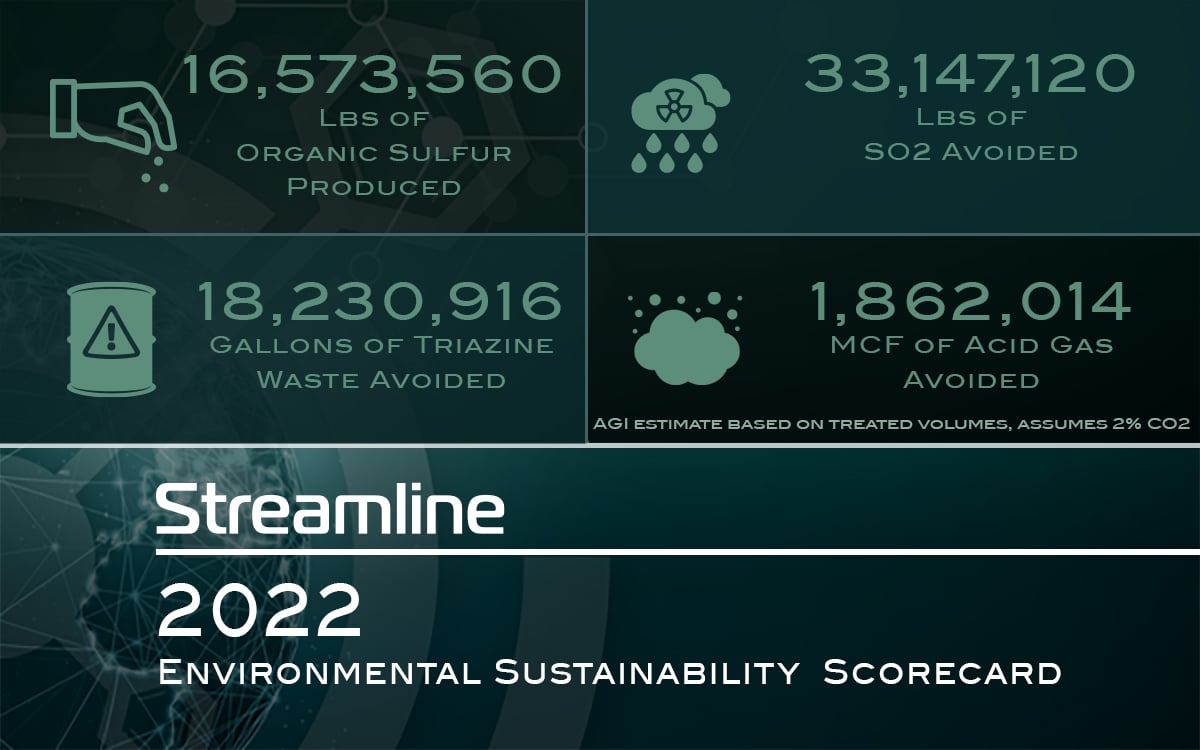
The infographic below aggregates the environmental sustainability benefits delivered to our customers by VALKYRIE units operating during 2022.

Streamline 2022 Sustainability Scorecard

In 2022, the VALKYRIE fleet delivered substantial improvements in environmental performance, as compared to 2021:

  • 42% increase in organic sulfur production
  • 42% increase in avoided SO2 emissions
  • 42% increase in avoided gallons of triazine waste
  • 38% increase in avoided acid gas produced

“Leading E&P operators are using Streamline technology to unlock the value of their sour gas assets in a cost-efficient and environmentally friendly manner. The VALKYRIE Environmental Sustainability Scorecard demonstrates the quantifiable environmental benefits of our technology.”

– David Sisk, CEO

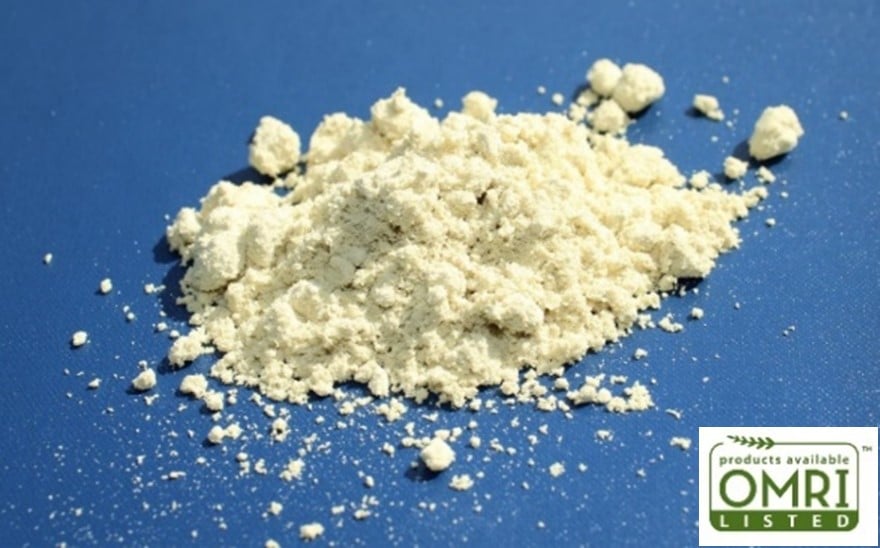
Streamline’s sulfur produced by the Valkyrie is listed as Simple Elemental Sulfur™ with the Organic Material Review Institute (“OMRI”) for use as fertilizer for Organic Production.  OMRI certification approval standards are compliant with the USDA National Organic Program (“NOP”) regulations for organic cultivation processes.  Simple Elemental Sulfur™ is a powdered, amorphous form of sulfur that can be beneficial as a soil amendment, increasing the pH of soil and improving the uptake of nitrogen. 


About Streamline Innovations

Streamline Innovation’s vision is Eliminating Emissions Through Technology.  We help heavy industry around the world achieve environmental performance objectives, improve sustainability, and transition to a sustainable, low-carbon economy.

Streamline’s environmentally forward H2S treating solutions help achieve the “E” in ESG. H2S is present in many industrial processes throughout the world.  Our technology can be applied across industries, delivering a sustainable solution that eliminates H2S, a leading cause of human inhalation accidents and source of SO2 emissions, a primary cause of acid rain.  Talon treats effectively in both gas and water phases.

Streamline believes that achieving environmental sustainability directives requires data. Creating intelligent systems that operate effectively and efficiently without human intervention is critical to measuring and reducing emissions that harm the environment.   We integrate advanced process control, data collection and analytics in our technologies to provide a total solution for customers.

We serve organizations in multiple sectors, including Energy/Oil & Gas, Biogas, Landfill Gas & Renewable Fuels, Municipal Wastewater and Industrial Air & Water.

Contact

Steve Bagley
Director, Corporate Development
Streamline Innovations, Inc.

steve.bagley@streamlineinnovations.com

The Role of Natural Gas

As we noted in our blog article Gas Treating – Processing Solutions for Multiple Industries, natural gas is expected to play a critical role in fulfilling future energy needs. The U.S. Energy Information Agency (EIA) forecasts that natural gas consumption will keep growing through 2050, maintaining the second-largest market share overall.

Coal-to-Gas Switching Driving Emissions Reduction

One of the major factors driving the forecasted increase in natural gas consumption is coal-to-gas switching. As coal-fired power plants are phased out, natural gas fired plants are picking up the slack.

EIA reports that emissions of CO2, a primary Greenhouse Gas (GHG) have declined substantially, primarily because of power generation switching to natural gas away from coal fired power plants. Further, EIA expects adoption of natural gas for power generation to increase through 2050 as it displaces coal as a primary feedstock.

Geologic Natural Gas Still Dominant

Although Renewable Natural Gas (RNG) production is increasing quickly as we noted in our article Gas Treating Solutions for Renewable Natural Gas, the vast majority of natural gas production in the U.S. is sourced from oil and gas wells, otherwise known as geologic natural gas. The Argonne National Laboratory estimated total RNG production capacity in the U.S. at 3% of total natural gas consumption in America. That means geologic natural gas will continue play the most essential role in meeting future energy demand.

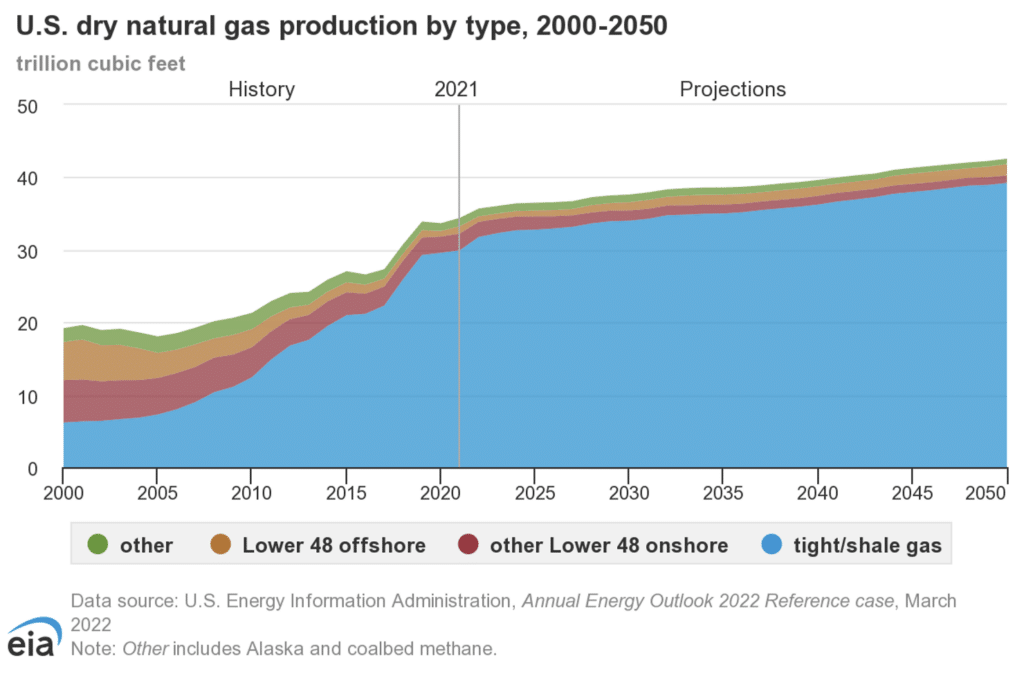
The chart below illustrates where geologic natural gas production is sourced from. Production from shale natural gas resource plays is driving the increase.

EIA chart - Natural gas Projection by Type

Why Does Sour Gas Need to be Treated?

The composition of geologic natural gas production varies widely between different regions in the United States. “Dry” natural gas produced from the Marcellus shale in the Northeast consists almost entirely of methane with very little contaminants and can be produced directly into commercial pipelines with very little or no treating.

In contrast, associated gas produced from the Permian Basin in West Texas and southeastern New Mexico and the Eagle Ford trend in southern Texas generally contains high levels of hydrogen sulfide (H2S) and CO2, making it “sour.”

Because H2S presents a significant threat to infrastructure integrity, most pipelines have stringent limits on H2S concentration that require producers to treat sour gas to remove or destroy the H2S. We provide more detail on natural gas pipeline gas specifications in our article Gas Treating – Processing Solutions for Multiple Industries.

Sour gas assets, typically located in established oil and gas producing regions equipped with infrastructure connecting them to national markets, have a critical role to play in meeting the nation’s energy needs and providing energy security. Gas treating solutions are required to unlock the value of these sour gas resources and sell the energy commercially into a pipeline.

Traditional Gas Treating Methods for Oil & Gas

In our article, Gas Sweetening, Sour Gas Treatment Strategies by Volume, we identified three primary categories of gas treating to remove H2S produced from oil and gas wells:

  • Scavengers and Adsorbents
  • Catalytic reactions
  • Mechanical destruction or Injection

These conventional H2S treatment methods are plagued with numerous downsides, including:

  • Create negative downstream processing effects
  • Require the use of chemicals that can be expensive and present a safety risk
  • Require the disposal of contaminated media, creating environmental and safety risks
  • Operational complexity, requiring frequent oversight on location and problem solving

Gas Treating Innovation – Liquid Redox

An innovative, proven solution for H2S gas treating is the current generation of  Liquid Redox. Liquid Redox has been around a while with mixed success.  The Streamline Valkyrie® Liquid Redox  (Reduction-Oxidation), with upgraded chemistry and automation, converts H2S into benign byproducts including elemental sulfur using chemistry (Reduction) that can be regenerated and be used again by exposure to oxygen (Oxidation).

The gas (i.e., Methane, CO2, other process gases) or air containing the H2S exits the system sweet (without H2S) and the elemental sulfur is filtered from the regenerated chemistry where the chemistry is recirculated to perform the reaction again and the sulfur is collected in a container available for reuse or disposal.

Our VALKYRIE H2S removal system uses this cost-efficient Redox (Reduction-Oxidation) process to help oil and gas operators unlock the value of sour gas resources.

The VALKYRIE system utilizes TALON® chemistry, our non-toxic, biodegradable Redox chemistry. In combination with our advanced automation and control technology, we have created “The Next Generation Redox” system.

Benefits of the VALKRYIE gas treating system:

  • A green solution that converts H2S into benign substances including water and elemental sulfur
  • Universal application for biogas, landfill gas and oil and gas production
  • Widest operating envelope of any H2S Treating method extending across the full spectrum of pressures, flow rates and H2S concentrations
  • Treating to established specifications for sales pipelines, gas lift and fuel gas
  • Flexibility of placement along the production stream whether at the anaerobic digester, at a landfill, wellhead, refinery, in a direct or tail gas treating configuration
  • We specialize in meeting the most stringent outlet specifications.

VALKYRIE gas treating units have been operating reliably for oil and gas producers in the Permian Basin and elsewhere, including Chevron Corporation and Franklin Mountain Energy among others.

Citations

EIA: Natural gas explained, Where our natural gas comes from

EIA: Annual Energy Outlook 2022

University of Texas Interstate Natural Gas – Quality Specifications & Interchangeability

SAN ANTONIO, TX (January 17, 2023) – Dr. Peter Photos, Chief Technical Officer with Streamline Innovations, Inc. (“Streamline”) is scheduled to deliver his presentation “The Valkyrie Process and Renewable Fuels: Moving into Greener Pastures” at the 73rd edition of the Laurance Reid Gas Conditioning Conference being held on February 20-23, 2023. The conference venue is the NCED Conference Center and Hotel in Norman, Oklahoma.

Streamline’s proven biodegradable chemistry and processes for gas treating convert toxic H2S into OMRI Certified elemental sulfur and water, which can be cleanly disposed of or used in agriculture as fertilizer. Many alternative gas treating solutions result in hazardous or toxic byproducts that require special handling.  In addition, Streamline’s chemistry is regenerative, leaving a small environmental footprint and consuming much less raw materials than scavengers and adsorbent media, while handling changes in flow and concentration better than biological solutions.

The technical paper, co-authored by Peter Photos Ph.D. and John Bourdon P.E., “The Valkyrie Process and Renewable Fuels: Moving into Greener Pastures” covers the urgent need for cost-effective methods for hydrogen sulfide (H2S) gas treating using Renewable Gas Sweetening in both geologic and bios-sourced gas production. Traditional methods for H2S gas treating leave producers with an unenviable choice of using either high capital cost Claus-based Sulfur Recovery Units or high operating cost scavengers. Streamline’s VALKYRIE® Renewable Gas Sweetening gas treating solution, however, uses ‘Next-Generation’ Liquid Redox technology, solving many of the issues of conventional Liquid Redox, while providing a scalable, efficient, and economic solutions down to less than 250 pounds per day of equivalent sulfur production.

The Laurance Reid Gas Conditioning Conference (LRGCC) has been presented by the University of Oklahoma since 1951. The LRGCC describes itself as the principal forum for new ideas, developments, and operations for preparing and purifying natural gases and other fuels for market. The LRGCC is a crucial oil and gas conference for all professionals involved in the gas processing, gas conditioning, and gas sweetening industries. The materials presented provide information on technological advances, case studies, theoretical breakthroughs, and current research in the field.

Contact

Steve Bagley
Director, Corporate Development
Streamline Innovations, Inc.
steve.bagley@streamlineinnovations.com

About Streamline Innovations

Streamline Innovation’s vision is Eliminating Emissions Through Technology.  We help heavy industry around the world achieve environmental performance objectives, improve sustainability, and transition to a sustainable, low-carbon economy.

H2S is present in almost every industrial process in the world.  Our technology can be applied across industries, delivering a sustainable solution that eliminates H2S, the leading cause of acid rain, a deadly greenhouse gas dangerous for work and living environments.

Streamline believes that achieving the E (“Environmental”) in ESG requires data. Creating intelligent systems that operate effectively and efficiently without human intervention is critical to reducing emissions that harm the environment.   We integrate advanced data collection, process control, and analytics in our technologies to provide a total solution for customers. We serve organizations in multiple sectors, including Energy/Oil & Gas, Biogas, Landfill Gas & Renewable Fuels, Municipal Wastewater and Industrial Air & Water.

The Role of Renewable Natural Gas (RNG)

Renewable Natural Gas (RNG) is poised to play an essential role in helping provide reliable energy to a growing world population while reducing emissions of methane and other substances that cause climate change.

The World Bank forecasts solid waste will increase nearly 70% by 2050, as the world population grows. Landfills are significant sources of methane emissions. An article in Science Advances describes using satellite imagery and analysis to estimate that landfills are the third largest source of methane emissions globally, trailing oil & gas systems and agriculture.

The Coalition for Renewable Natural Gas (RNG Coalition) notes, “Because RNG captures emissions from society’s waste streams and redeems its energy value, it has the lowest lifecycle carbon intensity (CI) of any clean energy source available today. RNG helps decarbonize energy and combats climate change.”

RNG is not just about landfills, it is potentially about all organic wastes.  For example, agricultural operations are the second largest source of methane emissions. According to U.S. Dairy, there are approximately 29,000 dairy farms in the United States, supplying humans with nutrient-dense milk and other dairy products. Cows stand at the top of the dairy product stream providing the milk supply, but their manure is a significant source of methane emissions. Collecting the manure into Anaerobic Digesters and capturing the methane it produces as it breaks down creates a potentially lucrative source of biogas.

Simply put, RNG whether it is sourced from landfills or agricultural operations is a win-win for humanity and the environment.

The Problem with Selling Biogas and Landfill Gas

Biogas and landfill gas in their raw states have some of the same problems that affect geologic natural gas produced from oil and gas wells – these raw gas streams typically contain impurities at levels that often exceed pipeline specification. Most commercial pipelines have specifications for contaminants, including oxygen, hydrogen sulfide, carbon dioxide, and other substances, to protect infrastructure and maintain safety.

Before biogas and landfill gas can be added to the gas grid, it must be upgraded or purified into RNG by removing carbon dioxide and other contaminants such as H2S, water, oxygen, and siloxanes to meet pipeline specifications. Hydrogen sulfide (H2S) is one of the most common contaminants of gas sourced from Anaerobic Digesters and Landfills, however, H2S is highly corrosive to metal pipelines, valves, and other equipment. It is critical to keep H2S out of the system to avoid the risk of a catastrophic failure.

As we noted in our article Gas Treating – Processing Solutions for Multiple Industries, The University of Texas found that the interstate pipeline specifications for H2S range between 0.25 grains per 100 cubic feet to 1.0 grains. Natural gas producers must take steps to decontaminate, purify and/or otherwise upgrade their produced gas to meet pipeline specifications.

Gas Treating for Upgrading to RNG

In our article, Gas Sweetening, Sour Gas Treatment Strategies by Volume, we identified the three primary categories of gas treating to remove H2S from landfill gas, biogas and natural gas produced from oil and gas wells:

  • Scavengers and Adsorbents
  • Catalytic reactions
  • Mechanical destruction or Injection into disposal wells

Conventional H2S treatment methods, including scavengers, adsorbents and catalytic reactions are plagued with a variety of downsides:

  • Create negative downstream processing effects
  • Require the use of chemicals that can be expensive and present a safety risk
  • Require the disposal of contaminated media, creating environmental and safety risks
  • Operational complexity, requiring frequent oversight on location and problem solving

Liquid Redox Solution for Gas Treating

In our VALKYRIE™ H2S removal system, we have commercialized a Redox (Reduction-Oxidation) process for converting H2S into elemental sulfur using chemistry (Reduction) that can be regenerated and be used again by exposure to air (Oxidation).

The gas (i.e., Methane, CO2, other process gases) containing the H2S exits the system sweet (without H2S) and the elemental sulfur is filtered from the regenerated chemistry where the chemistry is recirculated to perform the reaction again and the sulfur is collected in a container available for reuse or disposal.

The VALKYRIE system utilizes TALON® chemistry, our non-toxic, biodegradable Redox chemistry. In combination with our advanced automation and control technology, we have created “The Next Generation Redox” system.

Benefits of the VALKRYIE gas treating system:

  • A green solution that converts H2S into benign substances including water and elemental sulfur
  • Universal application for biogas, landfill gas and oil and gas production
  • Widest operating envelope of any H2S Treating method extending across the full spectrum of pressures, flow rates and H2S concentrations
  • Treating to established specifications for sales pipelines, gas lift and fuel gas
  • Flexibility of placement along the production stream whether at the anaerobic digester, at a landfill, wellhead, refinery, in a direct or tail gas treating configuration
  • 100% turndown

We specialize in meeting the most stringent outlet specifications.

Citations

World Bank press release, September 20, 2018

EPA Livestock Anaerobic Digester Database

Physics.org, Satellite data finds landfills are methane ‘super emitters’ 

U.S. Dairy, How Dairy Farmers Are Reducing Methane And Greenhouse Gas Emissions

SAN ANTONIO, TX (December 7, 2022) – Jacob Pratt, Senior Vice President of Sales with Streamline Innovations, Inc. (“Streamline”) will be attending the annual RNG Conference 2022 on December 12-15, 2022. The conference venue is the Waldorf Astoria Monarch Beach Resort & Club in Dana Point, California.

Interested parties are invited to schedule an appointment with Jacob to learn more about Streamline’s solutions for removing H2S from biogas produced from Anaerobic Digestion and Landfills.

Streamline’s proven biodegradable chemistry and processes convert toxic H2S into OMRI Certified elemental sulfur and water, which can be cleanly disposed of or used in agriculture as fertilizer. Many alternative treatment solutions result in hazardous or toxic byproducts that require special handling.  In addition, Streamline’s chemistry is regenerative, leaving a small environmental footprint and consuming much less raw materials than scavengers and adsorbent media, while handling changes in flow and concentration better than biological solutions.

Streamline’s VALKRYIE® ECO™ solution is highly effective in removing H2S from low pressure gas streams (-1 to 3 psig) with high and/or variable H2S concentrations.

The Renewable Natural Gas Conference is managed by The Coalition for Renewable Natural Gas (RNG Coalition), which serves as the public policy advocate and education platform for Renewable Natural Gas in North America. The RNG Conference boasts registered attendance of nearly 1,000 industry leaders, including executives, principals and decision-makers from across the RNG value and supply chain.

Contact

Jacob Pratt
Senior Vice President – Sales
Streamline Innovations, Inc.
Jacob.Pratt@streamlineinnovations.com

About Streamline Innovations

Streamline Innovation’s vision is Eliminating Emissions Through Technology.  We help heavy industry around the world achieve environmental performance objectives, improve sustainability, and transition to a sustainable, low-carbon economy.

H2S is present in almost every industrial process in the world.  Our technology can be applied across industries, delivering a sustainable solution that eliminates H2S, the leading cause of acid rain, a deadly greenhouse gases dangerous for work and living environments.

Streamline believes that achieving the E (“Environmental”) in ESG requires data. Creating intelligent systems that operate effectively and efficiently without human intervention is critical to reducing emissions that harm the environment.   We integrate advanced data collection, process control, and analytics in our technologies to provide a total solution for customers.

We serve organizations in multiple sectors, including Energy/Oil & Gas, Biogas, Landfill Gas & Renewable Fuels, Municipal Wastewater and Industrial Air & Water.