

Loading
Making heavy industry cleaner, sustainable, more profitable.

In an effort to strategically support the continued growth and development of green solutions for treating hydrogen sulfide (H2S), Streamline Innovations is pleased to welcome Jacob Pratt as the Senior Vice President of Sales.

Mr. Pratt joins Streamline at a time when demand for green solutions for treating H2S is rapidly increasing in both Oil & Gas and Renewable Natural Gas (RNG) markets.

Randy Rohlfs, Chief Commercial Officer with Streamline, said, “We are excited to welcome Jacob Pratt to Streamline in his new sales leadership role. His experience in sales management, systems and leadership will help scale our business development processes and improve our responsiveness to the market. In particular, his expertise in Renewable Natural Gas markets will be a strong asset to our team and uniquely positions Streamline to become the leading provider of green H2S solutions in the markets we serve.”

Streamline Innovations offers the Energy, Renewable Natural Gas, Wastewater and Industrial markets green solutions for treating H2S and odor control. Our flagship VALKYRIE® solution is a cost-effective, green technology that permanently dismantles the hydrogen sulfide molecule into harmless substances, eliminates flaring and allows customers to unlock the value of their sour gas and biogas assets in an environmentally friendly way.

Mr. Pratt has more than 16 years of professional experience in sales, sales management, gas treating and leadership. Most recently, he served as the Senior Development Director for Strategic Accounts and Virtual Pipeline Solutions at Vision RNG where he developed opportunities to help landfills reduce emissions, mitigate odors and supply the market with RNG. Prior to that, he served as the Vice President Renewable Natural Gas for Certarus Ltd. where he led development and management of the Certarus RNG platform to assist Anaerobic Digestion (AD) and Landfill projects get their RNG to market where pipeline is not an option.

Jacob Pratt, Senior Vice President of Sales, remarked, “As the RNG market continues to generate momentum and energy companies continue to seek environmentally friendly solutions to reduce emissions, I am thrilled to join the Streamline team. The company’s innovative technology offers natural gas, biogas and landfill gas producers a green solution for decontaminating and upgrading their production to meet pipeline specification, unlocking the value of sour gas assets and creating new revenue streams. The Streamline team has built a fantastic platform and I look forward to helping the company scale up aggressively.”

About Streamline Innovations

Streamline Innovations’ vision is Eliminating Emissions Through Technology. We help heavy industry around the world achieve environmental performance objectives, improve sustainability, and transition to a sustainable, low-carbon economy.

Streamline’s environmentally forward H2S treating solutions help our customers achieve environmental performance by significantly reducing emissions with our green H2S solutions for gas treating and gas sweetening. H2S is present in many industrial processes throughout the world, and our technology can be applied across industries, delivering a sustainable solution that eliminates H2S, a leading cause of human inhalation accidents, corrosion and SO2 emissions, a primary cause of acid rain.

We also believe that achieving climate-improving directives requires data. Creating intelligent systems that operate effectively and efficiently without human intervention is critical to measuring and reducing emissions that harm the environment. We integrate advanced process control, data collection and analytics in our technologies to provide a total solution for customers.

We serve organizations in multiple sectors, including Energy/Oil & Gas, Biogas, Landfill Gas & Renewable Fuels, Municipal Wastewater and Industrial Air & Water.

Contact

Randy Rohlfs
Chief Commercial Officer
Streamline Innovations
randy.rohlfs@streamlineinnovations.com

The Importance of Natural Gas

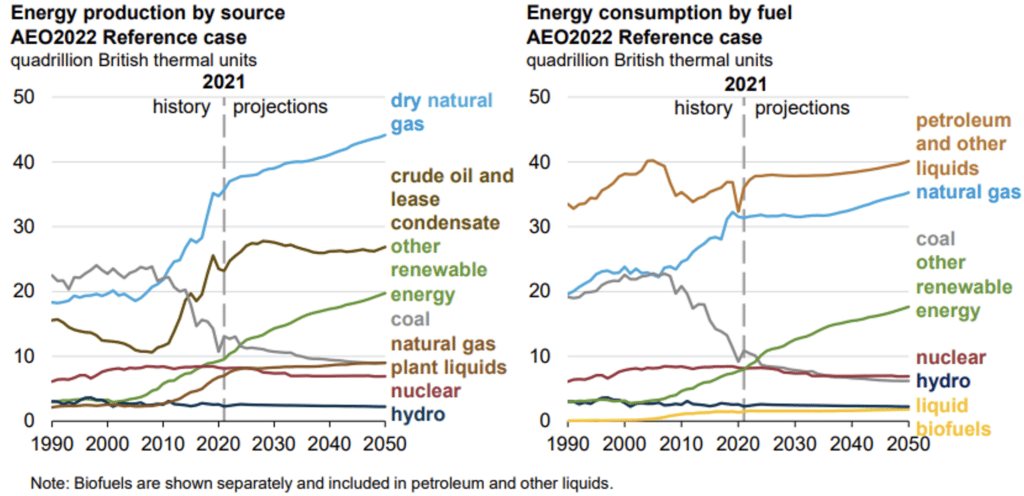
Every realistic forecast of energy demand recognizes the critical role of natural gas in fulfilling future energy needs. The U.S. Energy Information Agency (EIA) forecasts that natural gas consumption will keep growing through 2050, maintaining the second-largest market share overall.

In the EIA Reference case (base case charts referenced above), the industrial sector has the largest share of natural gas consumption, starting in the early 2020s, driven by greater use of natural gas as a feedstock in the chemical industries and by increased heat-and-power consumption across multiple industries.

Where Does Natural Gas Come From?

Natural gas most commonly is produced from oil and gas wells. The consistency of the produced gas varies widely in North America, based on the characteristics of the oil and gas reservoir from which it was produced. More recently, however, gas production from sources other than the oil and gas industry are becoming more prominent.

  • Oil and gas. “Natural gas,” as it is most commonly thought of is produced from oil and gas wells.
  • Biogas. Produced from agricultural operations or other sources of organic wastes using anaerobic digesters to convert waste organic materials into methane and other gasses are a growing source of “natural” gas.
  • Landfill gas. Landfills are often prolific sources of methane production.  Landfills have long been gathering gas to prevent leakage, but more and more they are producing gas commercially.
  • Renewable Natural Gas (RNG). Before biogas and landfill gas can be added to the gas grid, it must be upgraded or purified into RNG by removing carbon dioxide and other contaminants t  such as H2S, water, oxygen, and siloxanes to meet pipeline specifications.

Why Does Natural Gas Need to be Treated?

Natural gas produced from oil and gas wells, landfills or agricultural operations (biogas) almost always contains contaminants that must be removed before it can be sold commercially into a pipeline.

Midstream operators, namely pipeline transportation companies, have stringent specifications for natural gas quality to protect infrastructure and maintain safety. H2S is highly corrosive to metal pipelines, valves and other equipment. It is critical to keep H2S out of the system to avoid the risk of a catastrophic failure.

The University of Texas found that the pipeline specifications for H2S, for example, for interstate pipelines range between 0.25 grains per 100 cubic feet to 1.0 grains. The same study also discovered that the typical oxygen content specification ranged between 0.2% to 1.0% by volume. Natural gas producers must take steps to decontaminate, purify and/or otherwise upgrade their produced gas to meet pipeline specifications.

Gas Treating for Industry

Given the importance of natural gas to meeting future energy demand and reducing emissions of Greenhouse gasses, gas treating to remove contaminants becomes a critical problem to solve.

In our article, Gas Sweetening, Sour Gas Treatment Strategies by Volume, we covered how natural gas, biogas, and water that contain sulfur compounds or ammonia are considered “sour.” In low concentrations, these contaminants can cause maleficent odors, and in higher concentrations they can create serious hazards to both infrastructure and human health.

We identified the three primary categories of gas treating to remove H2S from landfill gas, biogas and natural gas produced from oil and gas wells:

  • Scavengers and Adsorbents
  • Catalytic reactions
  • Mechanical destruction or Injection

Conventional H2S treatment methods, including scavengers, adsorbents and catalytic reactions are plagued with a variety of downsides:

  • Create negative downstream processing effects
  • Require the use of chemicals that can be expensive and present a safety risk
  • Require the disposal of contaminated media, creating environmental and safety risks
  • Operational complexity, requiring frequent oversight on location and problem solving

Liquid Redox Solution for Gas Treating

In our VALKYRIE™ H2S removal system, we have commercialized a Redox (Reduction-Oxidation) process for converting H2S into elemental sulfur using chemistry (Reduction) that can be regenerated and be used again by exposure to oxygen (Oxidation).

The gas (i.e., Methane, CO2, other process gases) or air containing the H2S exits the system sweet (without H2S) and the elemental sulfur is filtered from the regenerated chemistry where the chemistry is recirculated to perform the reaction again and the sulfur is collected in a container available for reuse or disposal.

The VALKYRIE system utilizes TALON® chemistry, our non-toxic, biodegradable Redox chemistry. In combination with our advanced automation and control technology, we have created “The Next Generation Redox” system.

Benefits of the VALKRYIE gas treating system:

  • A green solution that converts H2S into benign substances including water and elemental sulfur
  • Universal application for biogas, landfill gas and oil and gas production
  • Widest operating envelope of any H2S Treating method extending across the full spectrum of pressures, flow rates and H2S concentrations
  • Treating to established specifications for sales pipelines, gas lift and fuel gas
  • Flexibility of placement along the production stream whether at the anaerobic digester, at a landfill, wellhead, refinery, in a direct or tail gas treating configuration
  • 100% turndown
  • We specialize in meeting the most stringent outlet specifications.

Role of Natural Gas in Reducing Emissions

EIA reports that emissions of CO2, a primary Greenhouse Gas (GHG) have declined substantially, primarily as a result of power generation switching to natural gas away from coal fired power plants. Further, EIA expects adoption of natural gas for power generation to increase through 2050 as it displaces coal as a primary feedstock.

Citations

U.S. Energy Information Agency, Annual Energy Outlook 2022

Interstate Natural Gas – Quality Specifications and Interchangeability, Center for Energy Economics, University of Texas at Austin

SAN ANTONIO, TX (October 6, 2022) – Representatives from Streamline Innovations, Inc. (“Streamline”) will be at the Water Environment Federation’s Technical Exhibition and Conference (WEFTEC) on October 10-12, 2022. The conference venue is the The Ernest N. Morial Convention Center in New Orleans, Louisiana.

Interested parties are invited to schedule an appointment to learn more about Streamline’s green solutions for treating H2S in wastewater and biogas, and for odor control.

For wastewater applications, Streamline’s TALON® Sulfide Elimination System (TSES™) doesn’t mask the problem, we remove the issue before it becomes a problem.  We are highly effective in both aqueous phase and gas phase.

For anaerobic digesters, Streamline’s VALKRYIE™ ECO™ solution is highly effective in removing H2S from low pressure gas streams with high and/or variable H2S.

TSES™ is a low to no capex solution for treating H2S in water and wastewater, eliminating the source of foul odors, corrosion and cross reactions with other chemical processes.  The TSES utilizes our TALON Redox catalyst combined with an oxygen source, creating an advanced oxidation process that breaks apart H2S and converts it to elemental sulfur.  In addition, TALON is used for advanced oxidization of other contaminants including dissolved organic matter, volatile organic compounds, and metals along with sludge solids to control H2S and odor issues.

WEFTEC describes itself as the industry’s premier water quality event and this year’s conference and expo will be the event’s 95th edition. There is no better place than WEFTEC to meet water professionals from around the world and experience first-hand the best in water quality education, leading experts, the latest technology and trends, and proven solutions. Create connections and transform tomorrow at WEFTEC 2022.

More information about the conference can be found on the WEFTEC website at www.weftec.org.

Contact

Stewart North
Director, Business Development – Water & Industrial
Streamline Innovations, Inc.
stewart.north@streamlineinnovations.com

Steve Bagley
Director, Corporate Development
Streamline Innovations, Inc.
steve.bagley@streamlineinnovations.com

About Streamline Innovations

Streamline Innovation’s vision is Eliminating Emissions Through Technology.  We help heavy industry around the world achieve environmental performance objectives, improve sustainability, and transition to a sustainable, low-carbon economy.

H2S is present in almost every industrial process in the world.  Our technology can be applied across industries, delivering a sustainable solution that eliminates H2S, the leading cause of acid rain, a deadly greenhouse gases dangerous for work and living environments.

Streamline believes that achieving the E (“Environmental”) in ESG requires data. Creating intelligent systems that operate effectively and efficiently without human intervention is critical to reducing emissions that harm the environment.   We integrate advanced data collection, process control, and analytics in our technologies to provide a total solution for customers.

We serve organizations in multiple sectors, including Energy/Oil & Gas, Biogas, Landfill Gas & Renewable Fuels, Municipal Wastewater and Industrial Air & Water.

SAN ANTONIO, TX (September 30, 2022) – Representatives from Streamline Innovations, Inc. (“Streamline”) will be at the Annual Meeting of the New Mexico Oil and Gas Association (NMOGA) on October 2-4, 2022. The conference venue is the Eldorado Hotel, Santa Fe.

Interested parties are invited to schedule an appointment to learn more about Streamline’s green solutions for treating H2S and unlocking the value of sour gas resources. Currently, Chevron is using Streamline Innovations VALKYRIE™ H2S treatment plants in the Permian Basin region of New Mexico to treat sour gas so it can be sold.

Streamline’s proven biodegradable chemistry and processes convert toxic H2S into elemental sulfur and water, which can be cleanly disposed of or used in agriculture as fertilizer. Many alternative treatment solutions result in hazardous or toxic byproducts that require special handling.  In addition, Streamline’s chemistry is regenerative, leaving a small environmental footprint and consuming much less raw materials that scavengers and adsorbent media, while handling changes in flow and concentration better than biological solutions.

NMOGA describes its Annual Meeting as one of the oldest and largest oil and natural gas gatherings in the United States, and regularly attracts more than 1,000 top industry leaders and executives, as well as state and federal elected and regulatory officials, to network, build business relationships, and learn the latest about New Mexico’s thriving oil and natural gas industry.

More information about the conference can be found on the NMOGA website at www.nmoga.org.

Contact

Randy Rohlfs
Chief Commercial Officer
Streamline Innovations
randy.rohlfs@streamlineinnovations.com

About Streamline Innovations

Streamline Innovation’s vision is Eliminating Emissions Through Technology.  We help heavy industry around the world achieve environmental performance objectives, improve sustainability, and transition to a sustainable, low-carbon economy.

H2S is present in almost every industrial process in the world.  Our technology can be applied across industries, delivering a sustainable solution that eliminates H2S, the leading cause of acid rain, a deadly greenhouse gases dangerous for work and living environments.

Streamline believes that achieving the E (“Environmental”) in ESG requires data. Creating intelligent systems that operate effectively and efficiently without human intervention is critical to reducing emissions that harm the environment.   We integrate advanced data collection, process control, and analytics in our technologies to provide a total solution for customers.

We serve organizations in multiple sectors, including Energy/Oil & Gas, Biogas, Landfill Gas & Renewable Fuels, Municipal Wastewater and Industrial Air & Water.

  • Streamline’s VALKYRIE technology is a green solution for treating sour gas, helping oil and gas producers unlock the value of sour gas assets in an environmentally friendly way
  • VALKYRIE units have been deployed to a Chevron production pad in the Permian Basin and have been operating reliably for four consecutive months

SAN ANTONIO, TEXAS (September 28, 2022)

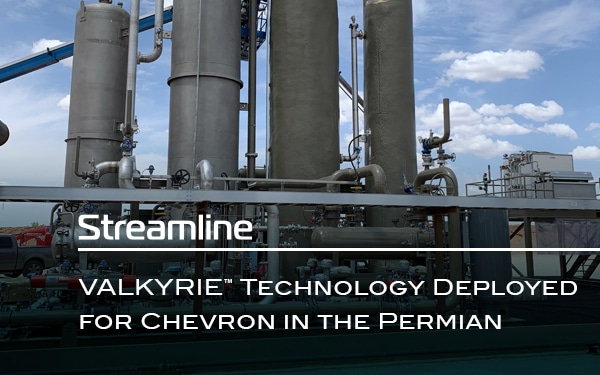
Streamline Innovations, Inc. (“Streamline”) announced it is providing Chevron a solution for treating hydrogen sulfide (H2S) in the Permian Basin.

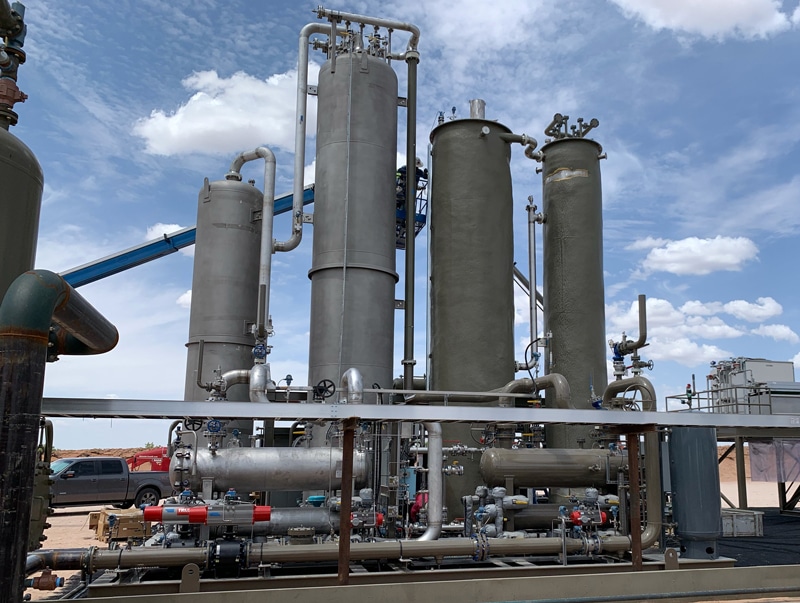
Valkyrie™ 1-Ton Skid in the Permian Basin
Streamline Innovations VALKYRIE™ 1-Ton Skid located in the Permian Basin.

VALKYRIE H2S treatment technology helps oil and gas producers overcome the constraint of limited sour take-away capacity, allowing the operator to produce and sell more oil and gas. Streamline’s technology safely and effectively treats H2S without flaring or injecting acid gas.

We recently deployed Streamline VALKYRIE 1.0 LTPD Skid Units to a Chevron location in Lea County, New Mexico. The units have been operating successfully for four months, helping Chevron develop and produce its sour gas assets in the area.

“Our VALKYRIE technology represents a green revolution for treating sour gas and is a true game-changer,” said Randy Rohlfs, Chief Commercial Officer with Streamline Innovations. “The VALKYRIE solution is a cost-effective, green technology that permanently dismantles the hydrogen sulfide molecule into harmless substances, eliminates flaring and allows operators to unlock the value of their sour gas assets in an environmentally friendly way.”

Randy Rohlfs, Chief Commercial Officer

Streamline is managing, servicing, and maintaining the fleet of VALKYRIE units under a Service Agreement, providing a turnkey solution to Chevron.

About Streamline Innovations

Streamline Innovations’ vision is Eliminating Emissions Through Technology. We help heavy industry around the world achieve environmental performance objectives, improve sustainability, and transition to a sustainable, low-carbon economy.

Streamline’s environmentally forward H2S treating solutions help our customers achieve environmental performance by significantly reducing emissions with our green H2S solutions. H2S is present in many industrial processes throughout the world, and our technology can be applied across industries, delivering a sustainable solution that eliminates H2S, a leading cause of human inhalation accidents, corrosion and SO2 emissions, a primary cause of acid rain.

We also believe that achieving climate-improving directives requires data. Creating intelligent systems that operate effectively and efficiently without human intervention is critical to measuring and reducing emissions that harm the environment. We integrate advanced process control, data collection and analytics in our technologies to provide a total solution for customers.

We serve organizations in multiple sectors, including Energy/Oil & Gas, Biogas, Landfill Gas & Renewable Fuels, Municipal Wastewater and Industrial Air & Water.

Visit streamlineinnovations.com for more information.

Contact

Randy Rohlfs
Chief Commercial Officer
Streamline Innovations
randy.rohlfs@streamlineinnovations.com

In our blog article Gas Sweetening | Sour Gas Treatment Strategies by Volume, we covered how natural gas, biogas, and water that contain sulfur compounds is considered “sour.” In low concentrations, these contaminants can cause maleficent odors, and in higher concentrations they can create serious hazards to both infrastructure and human health.

When methane gas is contaminated with hydrogen sulfide (H2S) or other sulfur compounds it is sour, whether it is produced from an oil and gas well or generated in an anaerobic digester as part of a Renewable Natural Gas (RNG) project. Considering methane gas, whether produced from a well producing from an underground oil and gas reservoir or generated on the surface in an anaerobic digester or landfill, being sour usually refers to the presence of hydrogen sulfide (H2S). Whether in the context of natural gas or biogas, gas sweetening is synonymous with hydrogen sulfide removal, also known as desulfurization.

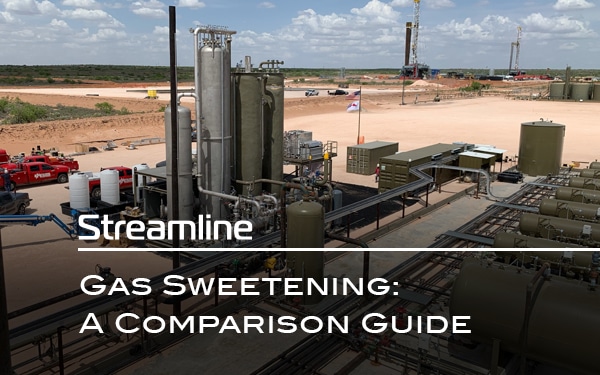
The comparison guide below summarizes the major differences between gas sweetening methods, including their pros and cons.

MethodOperational FactorsEnvironmental Factors
Liquid Redox• Chemistry is reused, resulting in lower total cost
• No hazardous disposal requirements
Green technology with harmless byproducts, including elemental sulfur, which can be put to beneficial use
Scavengers and Adsorbents
• Frequent media changes
 
• Personnel can be exposed to chemicals and potential spontaneous combustion
 
• Can generate negative downstream effects
• H2S is not permanently destroyed, could eventually come out
 
• In most cases, must be disposed of in hazardous waste facility
Claus Process
• Established, proven process
 
• Requires large and expensive facilities staffed by skilled personnel
 
• Process efficiency does not reach 100% without recycling and tail gas treating

Desulfurizing creates crystalized elemental sulfur, which the main source for industrial applications
Biologics• Sensitive to process changes and upsets, not good for intermittent production scenarios
 
• Chemistry is high-alkalinity which must be diluted with water for HS&E concerns
 
• Requires larger footprint than other methods
• Biological regeneration is a green process
Flaring/Combusting• Routine flaring wastes a valuable natural resource that could otherwise be sold
 
• Reduced asset values
 
• Negative impact on community relations
• Flaring sour gas produces sulfur dioxide (SO2) emissions, a cause of acid rain
 
• Makes it more difficult to achieve environmental performance goals (e.g., achieving net zero)

As the next generation Redox process, Streamline’s VALKYRIE® H2S treating units use our patented TALON® chemistry, to provide a green solution for gas sweetening without the negatives associated with other gas treating alternatives.

VALKYRIE® units have the widest operating envelope of any treating technology relating to pressure, gas volume and H2S concentration with the lowest total lifecycle cost per pound of sulfur removed compared to all other competitors.  The VALKYRIE unit provides numerous tangible ancillary benefits.

SAN ANTONIO, TX (September 12, 2022) – Representatives from Streamline Innovations, Inc. (“Streamline”) will be at the RNG Works 2022 Technical Workshop and Trade Expo on September 20-22, 2022. The conference venue is the Music City Center in Nashville, Tennessee.

Interested parties are invited to schedule an appointment to learn more about Streamline’s solutions for removing H2S from biogas produced from Anaerobic Digestion and upgrading it to biomethane.

Streamline’s proven biodegradable chemistry and processes convert toxic H2S into elemental sulfur and water, which can be cleanly disposed of or used in agriculture as fertilizer. Many alternative treatment solutions result in hazardous or toxic byproducts that require special handling.  In addition, Streamline’s chemistry is regenerative, leaving a small environmental footprint and consuming much less raw materials that scavengers and adsorbent media, while handling changes in flow and concentration better than biological solutions.

Streamline’s VALKRYIE™ ECO™ solution is highly effective in removing H2S from low pressure gas streams with high and/or variable H2S concentrations.

RNG WORKS describes itself as a venue to educate, demonstrate and promote RNG industry best practices, for purposes of helping realize sustainable development, deployment and utilization of renewable natural gas – and for purposes of helping achieve greater energy independence and access to domestic, renewable, clean fuel and energy supply.

Contact

Steve Bagley
Director, Corporate Development
Streamline Innovations, Inc.
steve.bagley@streamlineinnovations.com

About Streamline Innovations

Streamline Innovation’s vision is Eliminating Emissions Through Technology.  We help heavy industry around the world achieve environmental performance objectives, improve sustainability, and transition to a sustainable, low-carbon economy.

H2S is present in almost every industrial process in the world.  Our technology can be applied across industries, delivering a sustainable solution that eliminates H2S, the leading cause of acid rain, a deadly greenhouse gases dangerous for work and living environments.

Streamline believes that achieving the E (“Environmental”) in ESG requires data. Creating intelligent systems that operate effectively and efficiently without human intervention is critical to reducing emissions that harm the environment.   We integrate advanced data collection, process control, and analytics in our technologies to provide a total solution for customers.

We serve organizations in multiple sectors, including Energy/Oil & Gas, Biogas, Landfill Gas & Renewable Fuels, Municipal Wastewater and Industrial Air & Water.

SpaceX will provide Streamline with secure access to the cloud and Internet for remote monitoring and control capabilities.

Starlink connectivity provides us with reliable, secure, and fast cutting-edge communications with our equipment in the field worldwide. This capability increases Streamline’s operational and communications footprint to remote locations where there is no phone or internet access, allowing us to deliver cutting-edge automation capabilities nearly anywhere in the world.

Organizations with broad operational footprints, like Energy companies, organizations with presences at the network edge or those operating in rural or remote areas require reliable and secure cloud access to take advantage of automation, artificial intelligence, or machine learning. Connectivity from the Starlink constellation of low-Earth-orbit satellites provides these organizations with reliable and secure access for operations geographically dispersed across regions and countries.

Streamline is a recognized leader in deploying new automation, controls, and communications in its mission to reduce emissions through technology. Streamline will begin deploying Starlink by the fourth quarter of 2022.

Contact

Steve Bagley
Director, Corporate Development
Streamline Innovations, Inc.
steve.bagley@streamlineinnovations.com

Natural gas, biogas, and water that contain sulfur compounds or ammonia are considered “sour.” In low concentrations, these contaminants can be the source of maleficent odors, while in higher concentrations they can present hazards to infrastructure from corrosion and human health from respiratory illnesses and in some cases death. Treating sourness in fluids is called gas sweetening, because it makes it “less sour” by removing the sulfur and ammonia contaminants.

When it comes to methane gas, whether it is produced from a well drilled deep into the earth or generated on the surface in an anaerobic digester, being sour usually refers to the presence of hydrogen sulfide (H2S). Whether in the context of natural gas or biogas, gas sweetening is synonymous with hydrogen sulfide removal, also known as desulfurization.

There are several strategies for gas sweetening based on several factors, including:

  • The volume of gas to be treated
  • The concentration of H2S in the gas stream
  • How the gas is being used
  • What applicable environmental regulations will allow. 

One traditional method for using or disposing of sour gas is to burn it either as a fuel source for a generator or steam boiler or flared it off as a waste product. Burning sour gas eliminates the H2S, however, the reaction also creates sulfur dioxide, which is considered a harmful pollutant and a major contributor to acid rain.

Gas sweetening decontaminates gas streams so they can be commercialized or disposed of in a way that does not generate harmful byproducts, like SO2

There are three main groupings of gas sweetening methods:

  1. Scavengers and Adsorbents
  2. Catalytic reactions
  3. Mechanical destruction or Injection

Scavengers and Adsorbents. Scavengers and adsorbents are typically one-and-done solutions. When using a scavenger, a chemical reaction between the scavenger element and H2S “traps” the hydrogen sulfide, but it does remove it and the spent scavenger media must be disposed of as a hazardous waste.  In the case of adsorbents, the H2S is chemically bonded to the surface of the media, leaving solid wastes for disposal.

Amine scrubbers. For high volumes of gas, sweetening means using an amine scrubber or other selective gas stripping process to concentrate the H2S, after which the resulting “acid gas” stream can then be combusted (thermal oxidation), injected into a specially permitted Acid Gas Injection well (AGI), or destroyed mechanically, chemically, or biologically.

Claus process. For very large volumes of gas and high H2S concentrations, such as at a gas plant or a refinery, the Claus process is employed to mechanically destroy H2S.  The Claus process is a large-scale method that is not suitable for projects that are small, short term, or have high variability in volume.

Biologics. Biological sweetening consists of stripping the H2S out of the gas with an aqueous soda solution and then exposing the H2S -rich solution to thiobacillus bacteria which consume the H2S, leaving elemental sulfur.  This process can be slow to adapt to changes in gas volumes or H2S concentrations.

Acid Gas Injection. AGI or Acid Gas Injection involves injected concentrated H2S gas mixed with CO2 (Acid Gas) into a formation deep in the earth.  While this can be a safe and permanent solution, it is expensive to get started and requires ongoing monitoring, as well as the transportation of the acid gas to the injection site.

Leveraging IIOT and Operational Technology for High Uptime and Reliability

Processing Magazine interviewed Streamline Innovation’s Chief Technology Officer, Peter Photos on how we use advanced SCADA, MQTT, edge computing and mobile capabilities to facilitate the automation of our VALKYRIE™ natural gas treating units.

Excerpt: “With this SCADA system, we’ve been able to reduce the number of man-hours for our systems to just a few hours a week, yet still maintain over 99% uptime. We didn’t think this was possible using current technology, but this off-the-shelf technology was able to facilitate our ability to do this.

Read the full story… Build your dream system on a flexible platform.

Contact

Steve Bagley
Director, Corporate Development
Streamline Innovations, Inc.
steve.bagley@streamlineinnovations.com

About Processing Magazine

Processing serves professionals across the process industries worldwide, including the chemical, food and beverage, pharmaceutical and petrochemical industries. With a monthly print magazine, digital issue and a variety of e-newsletters, Processing serves professionals who are focused on the development, management, maintenance and improvement of industrial processing operations to maximize product quality, output and profitability.

About Streamline Innovations

Streamline Innovations’ vision is Eliminating Emissions Through Technology. We help heavy industry around the world achieve environmental performance objectives, improve sustainability, and transition to a sustainable, low-carbon economy.

Streamline’s environmentally forward H2S treating solutions help our customers achieve the “E” in ESG. H2S is present in many industrial processes throughout the world, and our technology can be applied across industries, delivering a sustainable solution that eliminates H2S, a leading cause of human inhalation accidents, corrosion and SO2 emissions, a primary cause of acid rain.

We also believe that achieving climate-improving directives requires data. Creating intelligent systems that operate effectively and efficiently without human intervention is critical to measuring and reducing emissions that harm the environment. We integrate advanced process control, data collection and analytics in our technologies to provide a total solution for customers.

We serve organizations in multiple sectors, including Energy/Oil & Gas, Biogas, Landfill Gas & Renewable Fuels, Municipal Wastewater and Industrial Air & Water.