

The Importance of Natural Gas
Every realistic forecast of energy demand recognizes the critical role of natural gas in fulfilling future energy needs. The U.S. Energy Information Agency (EIA) forecasts that natural gas consumption will keep growing through 2050, maintaining the second-largest market share overall.
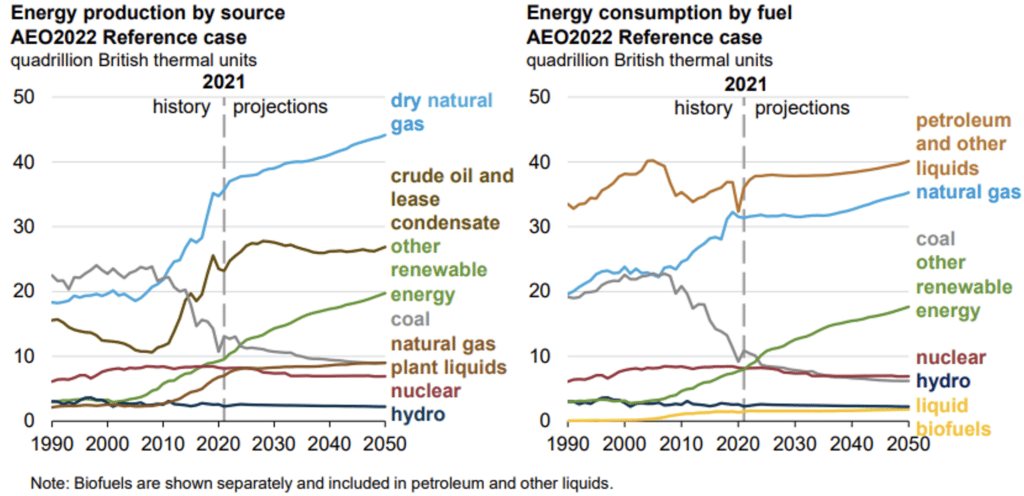
In the EIA Reference case (base case charts referenced above), the industrial sector has the largest share of natural gas consumption, starting in the early 2020s, driven by greater use of natural gas as a feedstock in the chemical industries and by increased heat-and-power consumption across multiple industries.
Where Does Natural Gas Come From?
Natural gas most commonly is produced from oil and gas wells. The consistency of the produced gas varies widely in North America, based on the characteristics of the oil and gas reservoir from which it was produced. More recently, however, gas production from sources other than the oil and gas industry are becoming more prominent.
- Oil and gas. “Natural gas,” as it is most commonly thought of is produced from oil and gas wells.
- Biogas. Produced from agricultural operations or other sources of organic wastes using anaerobic digesters to convert waste organic materials into methane and other gasses are a growing source of “natural” gas.
- Landfill gas. Landfills are often prolific sources of methane production. Landfills have long been gathering gas to prevent leakage, but more and more they are producing gas commercially.
- Renewable Natural Gas (RNG). Before biogas and landfill gas can be added to the gas grid, it must be upgraded or purified into RNG by removing carbon dioxide and other contaminants t such as H2S, water, oxygen, and siloxanes to meet pipeline specifications.
Why Does Natural Gas Need to be Treated?
Natural gas produced from oil and gas wells, landfills or agricultural operations (biogas) almost always contains contaminants that must be removed before it can be sold commercially into a pipeline.
Midstream operators, namely pipeline transportation companies, have stringent specifications for natural gas quality to protect infrastructure and maintain safety. H2S is highly corrosive to metal pipelines, valves and other equipment. It is critical to keep H2S out of the system to avoid the risk of a catastrophic failure.
The University of Texas found that the pipeline specifications for H2S, for example, for interstate pipelines range between 0.25 grains per 100 cubic feet to 1.0 grains. The same study also discovered that the typical oxygen content specification ranged between 0.2% to 1.0% by volume. Natural gas producers must take steps to decontaminate, purify and/or otherwise upgrade their produced gas to meet pipeline specifications.
Gas Treating for Industry
Given the importance of natural gas to meeting future energy demand and reducing emissions of Greenhouse gasses, gas treating to remove contaminants becomes a critical problem to solve.
In our article, Gas Sweetening, Sour Gas Treatment Strategies by Volume, we covered how natural gas, biogas, and water that contain sulfur compounds or ammonia are considered “sour.” In low concentrations, these contaminants can cause maleficent odors, and in higher concentrations they can create serious hazards to both infrastructure and human health.
We identified the three primary categories of gas treating to remove H2S from landfill gas, biogas and natural gas produced from oil and gas wells:
- Scavengers and Adsorbents
- Catalytic reactions
- Mechanical destruction or Injection
Conventional H2S treatment methods, including scavengers, adsorbents and catalytic reactions are plagued with a variety of downsides:
- Create negative downstream processing effects
- Require the use of chemicals that can be expensive and present a safety risk
- Require the disposal of contaminated media, creating environmental and safety risks
- Operational complexity, requiring frequent oversight on location and problem solving
Liquid Redox Solution for Gas Treating
In our VALKYRIE™ H2S removal system, we have commercialized a Redox (Reduction-Oxidation) process for converting H2S into elemental sulfur using chemistry (Reduction) that can be regenerated and be used again by exposure to oxygen (Oxidation).
The gas (i.e., Methane, CO2, other process gases) or air containing the H2S exits the system sweet (without H2S) and the elemental sulfur is filtered from the regenerated chemistry where the chemistry is recirculated to perform the reaction again and the sulfur is collected in a container available for reuse or disposal.
The VALKYRIE system utilizes TALON® chemistry, our non-toxic, biodegradable Redox chemistry. In combination with our advanced automation and control technology, we have created “The Next Generation Redox” system.
Benefits of the VALKRYIE gas treating system:
- A green solution that converts H2S into benign substances including water and elemental sulfur
- Universal application for biogas, landfill gas and oil and gas production
- Widest operating envelope of any H2S Treating method extending across the full spectrum of pressures, flow rates and H2S concentrations
- Treating to established specifications for sales pipelines, gas lift and fuel gas
- Flexibility of placement along the production stream whether at the anaerobic digester, at a landfill, wellhead, refinery, in a direct or tail gas treating configuration
- 100% turndown
- We specialize in meeting the most stringent outlet specifications.
Role of Natural Gas in Reducing Emissions
EIA reports that emissions of CO2, a primary Greenhouse Gas (GHG) have declined substantially, primarily as a result of power generation switching to natural gas away from coal fired power plants. Further, EIA expects adoption of natural gas for power generation to increase through 2050 as it displaces coal as a primary feedstock.

Citations
U.S. Energy Information Agency, Annual Energy Outlook 2022