
Biogas and landfill gas, generated from organic waste and decaying materials, hold tremendous potential as sustainable energy sources. To harness their full value and minimize greenhouse gas emissions, these gases can be upgraded and converted to Renewable Natural Gas (RNG). RNG, also known as biomethane, is a valuable commodity that can be sold to commercial pipelines.
In this article, we will explore the process of upgrading raw biogas and landfill gas to meet the specifications required for RNG production and distribution.
Understanding Biogas and Landfill Gas
Biogas and landfill gas are both produced through anaerobic digestion—the breakdown of organic matter in the absence of oxygen. Biogas is typically derived from agricultural waste, sewage sludge and food waste, while landfill gas is generated as a result of the decomposition of organic materials in landfills. These gases primarily consist of methane (CH4) and carbon dioxide (CO2), with smaller quantities of other gases such as hydrogen sulfide (H2S).
Challenges and Benefits of Upgrading
Raw biogas and landfill gas contain impurities such as water vapor, sulfur compounds, siloxanes and volatile organic compounds (VOCs), which need to be removed or reduced to meet the specifications required for RNG. Upgrading the gas serves several key purposes:
- Purity: Removal of impurities, especially H2S, ensures that RNG meets the quality standards necessary for injection into natural gas pipelines. This process maximizes the energy content and facilitates the integration of RNG into existing gas infrastructure.
- Environmental Benefits: Upgrading raw biogas and landfill gas significantly reduces their environmental impact. By removing impurities like CO2, RNG from Dairy and Swine feedstocks can have a carbon-neutral or even carbon-negative profile, making it an eco-friendly alternative.
- Financial Viability: Converting raw biogas and landfill gas into RNG enhances their economic value. RNG can be sold as a renewable energy commodity, attracting financial incentives, grants, and credits while also diversifying revenue streams for waste management facilities or biogas plant operators.
The Upgrading Process
The process of upgrading raw biogas and landfill gas involves multiple stages to achieve the desired purity and composition for RNG production. The common steps include:
- Conditioning: In this stage, the raw biogas or landfill gas is treated to remove moisture, particulate matter, and H2S Water vapor is condensed and removed through cooling, while solid particles are filtered out.
- CO2 Removal: To meet RNG specifications, the CO2 content must be reduced. Several technologies, such as pressure swing adsorption (PSA) and membrane separation, are employed to selectively remove CO2 from the gas mixture.
- Trace Impurity Removal: Further purification is necessary to remove trace impurities, including siloxanes and VOCs, which can cause equipment damage and reduce the quality of RNG. Technologies like activated carbon filters and thermal oxidation units are commonly used for this purpose.
The Importance of H2S Removal
Hydrogen sulfide (H2S) is a common impurity found in raw biogas and landfill gas. It is a corrosive and toxic gas that not only poses risks to equipment and infrastructure but also affects the overall quality and marketability of RNG. The presence of H2S in the gas stream can lead to operational challenges, reduced energy content, and increased maintenance costs. Therefore, effective removal of H2S is essential to meet the stringent standards required for RNG production.
Read our blog Meeting RNG Pipeline Specifications – The H2S Imperative
Traditional Techniques for H2S Removal
Several traditional techniques are employed to remove H2S from raw biogas and landfill gas during the upgrading process. Some of the commonly used methods include:
- Chemical Absorption: Chemical absorption involves passing the gas stream through an absorbent solution that selectively reacts with H2S, forming non-volatile compounds. One widely used absorbent is amine-based compounds, such as monoethanolamine (MEA) or diethanolamine (DEA). These chemicals have a high affinity for H2S and can effectively remove it from the gas mixture. The H2S is not destroyed and must be thermally oxidized, creating air pollution, of otherwise disposed.
- Biological Desulfurization: Biological desulfurization, also known as biodesulfurization or biogas desulfurization, employs specialized microorganisms to metabolize H2S present in the gas stream. These microorganisms convert H2S into elemental sulfur, which can be easily separated from the gas. Biological desulfurization offers an environmentally friendly and cost-effective approach to H2S removal. The primary downside to biologic methods is that they typically require a time-consuming startup period and are highly sensitive to changes in gas stream temperature, volume and composition. Surge production, for example, can overwhelm a biologic desulfurization unit resulting in extended downtime. At lower operating pressure additional treatment might be required to meet pipeline specifications.
- Solid Bed Adsorption: Solid bed adsorption involves using adsorbents, such as activated carbon or iron oxide-based materials, to adsorb H2S molecules from the gas stream. As the gas passes through the adsorbent bed, H2S adheres to the surface of the material, resulting in purified gas. Periodic replacement or regeneration of the adsorbent is necessary to maintain its effectiveness. Spent media must be changed and disposed of, having similar downsides to chemical absorbents. This works well for low concentrations of H2S, but becomes expensive, hard to change out and creates logistics headaches when H2S concentrations are higher.
Next Generation Liquid Redox for Removing H2S in Biogas-to-RNG Upgrading
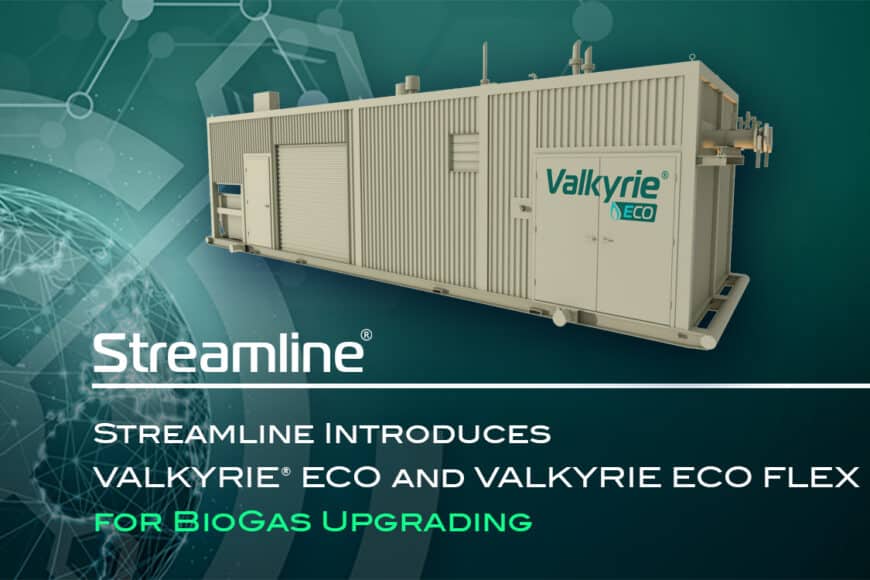
The VALKYRIE® H2S removal system from Streamline Innovations utilizes a Liquid Redox process for converting H2S into elemental sulfur and water vapor. VALKYRIE next generation Liquid Redox employs TALON® chemistry, our non-toxic, biodegradable chemistry to remove H2S and convert it into elemental sulfur (Reduction) and then regenerated and used again by exposure to oxygen (Oxidation).
A key benefit of the VALKYRIE ECO H2S removal system is its ability to treat to non-detect levels from a single skid without any additional conditioning equipment.
Benefits of the VALKRYIE gas treating system:
- A green solution that converts H2S into benign substances including water and elemental sulfur
- Universal application for biogas, landfill gas and oil and gas production
- Widest operating envelope of any H2S Treating method extending across the full spectrum of pressures, flow rates and H2S concentrations
- Treating to established specifications for sales pipelines, gas lift and fuel gas
- Flexibility of placement along the production stream whether at the anaerobic digester, at a landfill, wellhead, refinery, in a direct or tail gas treating configuration
- High turndown
- Specialize in meeting the most stringent outlet specifications
- Made in the USA
VALKYRIE H2S treating technology gives biogas and landfill gas producers a smart, economical and sustainable method for H2S removal in the Biogas-to-RNG upgrading process.
Learn more about Streamline’s VALKRYIE ECO and ECO FLEX Biogas-to-RNG Upgrading Technology.
Summary
H2S removal plays a critical role in the upgrading process of raw biogas and landfill gas for RNG production. By effectively removing H2S, the quality, marketability, and environmental impact of the final product are significantly improved.
Streamline VALKYRIE liquid redox technology provides biogas and landfill gas operators a proven, robust, and green method for permanently removing H2S from their RNG feedstocks.
About Streamline Innovations
Streamline Innovations’ vision is Eliminating Emissions Through Technology. We help heavy industry around the world achieve environmental performance objectives, improve sustainability, and transition to a sustainable, low-carbon economy.
Streamline’s environmentally forward H2S treating solutions help our customers achieve the “E” in ESG. H2S is present in many industrial processes throughout the world, and our technology can be applied across industries, delivering a sustainable solution that eliminates H2S, a leading cause of human inhalation accidents, corrosion and SO2 emissions, a primary cause of acid rain.
We also believe that achieving climate-improving directives requires data. Creating intelligent systems that operate effectively and efficiently without human intervention is critical to measuring and reducing emissions that harm the environment. We integrate advanced process control, data collection and analytics in our technologies to provide a total solution for customers.
We serve organizations in multiple sectors, including Energy/Oil & Gas, Biogas, Landfill Gas & Renewable Fuels, Municipal Wastewater and Industrial Air & Water.
Contacts
General Inquiries:
Randy Rohlfs
Chief Commercial Officer
Randy.Rohlfs@StreamlineInnovations.com
Sales Inquiries:
Jacob Pratt
SVP – Sales
Jacob.Pratt@StreamlineInnovations.com