Loading
Making heavy industry cleaner, sustainable, more profitable.

Streamline Innovations will be participating in the Abu Dhabi International Petroleum Exhibition and Conference (ADIPEC) scheduled for November 4-7, 2024. The event venue is the ADNEC Centre in Abu Dhabi, United Arab Emirates.

Randy Rohlfs, Chief Commercial Officer, and Jacob Pratt, Senior Vice President – Sales, is scheduled to deliver a presentation on November 4, 2024, at 1:00 PM Gulf Standard Time covering Streamline’s environmentally friendly H2S treating solutions for the Oil and Gas Industry.

Interested parties are invited to schedule an appointment with Messrs. Rohlfs or Pratt.

VALKYRIE® H2S Treating is a Strategic Technology

According to Middle East Oil and Gas, six of the world’s top 10 sour gas fields are in the Middle East, including locations in the UAE, Saudi Arabia, Qatar, and Egypt. These fields hold vast resources but contain high H2S levels, ranging from 5% to 23%.

Environmentally friendly H2S treatment methods are essential to unlocking these resources sustainably and cost-effectively. Streamline’s VALKYRIE H2S treatment solution provides oil and gas operators with a green, sustainable way to decontaminate sour gas, supporting the goal of eliminating routine flaring and achieving Net Zero by 2050.

The VALKYRIE technology converts toxic H2S into pure elemental sulfur, which can be safely disposed of or used as fertilizer. Currently, more than 50 VALKYRIE units are in operation in the U.S., helping leading oil and gas companies monetize sour gas assets sustainably and cost-effectively.

About ADIPEC

ADIPEC is hosted by the Abu Dhabi National Oil Company (ADNOC) and describes itself as including 10 conferences and over 370 sessions, ADIPEC will provide an inclusive stage for more than 1,800 speakers to address the most urgent global energy challenges. These leaders and innovators will offer diverse perspectives and approaches, sharing impactful insights from across the energy, finance, technology, manufacturing, transport and construction sectors.

Contact

Jacob Pratt
SVP – Sales
Streamline Innovations, Inc.
jacob.pratt@streamlineinnovations.com

About Streamline Innovations

Streamline Innovation’s vision is Reducing Emissions Through Technology.  We help heavy industry around the world achieve environmental performance objectives, improve sustainability, and transition to a sustainable, low-carbon economy.

TIME Magazine ranked Streamline in 6th place out of 250 companies included in TIME’s inaugural list of America’s Top GreenTech Companies 2024. This prestigious recognition is presented by TIME and Statista, Inc., a leading statistics portal and industry ranking provider. 

H2S is present in almost every industrial process in the world.  Our technology can be applied across industries, delivering a sustainable solution that eliminates H2S, the leading cause of acid rain, a deadly greenhouse gas dangerous for work and living environments.

Streamline believes that achieving the E (“Environmental”) in ESG requires data. Creating intelligent systems that operate effectively and efficiently without human intervention is critical to reducing emissions that harm the environment.   We integrate advanced data collection, process control, and analytics in our technologies to provide a total solution for customers.

We serve organizations in multiple sectors, including Energy/Oil & Gas, Biogas, Landfill Gas & Renewable Fuels, Municipal Wastewater and Industrial Air & Water.
Streamline Innovations will be at the New Mexico Oil & Gas Association (NMOGA) 2024 Annual Meeting on October 6-7. The event will be held in Santa Fe, New Mexico at the Eldorado Hotel & Spa.

Interested parties are invited to contact Randy Rohlfs, Chief Commercial Officer, to schedule an appointment to learn more about Streamline’s environmentally friendly solutions for removing H2S from natural gas streams.

VALKYRIE® H2S treating technology from Streamline Innovations provides operators with a reliable and proven solution for treating sour gas, helping oil and gas producers and midstream operators unlock the value of sour gas assets in an environmentally friendly way.

VALKYRIE gas treating units have been operating reliably for oil and gas producers in the Permian Basin and elsewhere, including Chevron Corporation and Franklin Mountain Energy.

The New Mexico Oil & Gas Association (NMOGA) is a coalition of oil and natural gas companies, individuals, and stakeholders dedicated to promoting the safe and environmentally responsible development of oil and natural gas resources in New Mexico. Representing over 1,000 members, NMOGA works with elected officials, community leaders, industry experts, and the general public, to advocate for responsible oil and natural gas policies and increase public understanding of industry operations and contributions to the state. 

Contact

Randy Rohlfs
Chief Commercial Officer
Streamline Innovations, Inc.
randy.rohlfs@streamlineinnovations.com

About Streamline Innovations

Streamline Innovation’s vision is Eliminating Emissions Through Technology.  We help heavy industry around the world achieve environmental performance objectives, improve sustainability, and transition to a sustainable, low-carbon economy.

H2S is present in almost every industrial process in the world.  Our technology can be applied across industries, delivering a sustainable solution that eliminates H2S, the leading cause of acid rain, a deadly greenhouse gases dangerous for work and living environments.

Streamline believes that achieving the E (“Environmental”) in ESG requires data. Creating intelligent systems that operate effectively and efficiently without human intervention is critical to reducing emissions that harm the environment.   We integrate advanced data collection, process control, and analytics in our technologies to provide a total solution for customers.

We serve organizations in multiple sectors, including Energy/Oil & Gas, Biogas, Landfill Gas & Renewable Fuels, Municipal Wastewater and Industrial Air & Water.
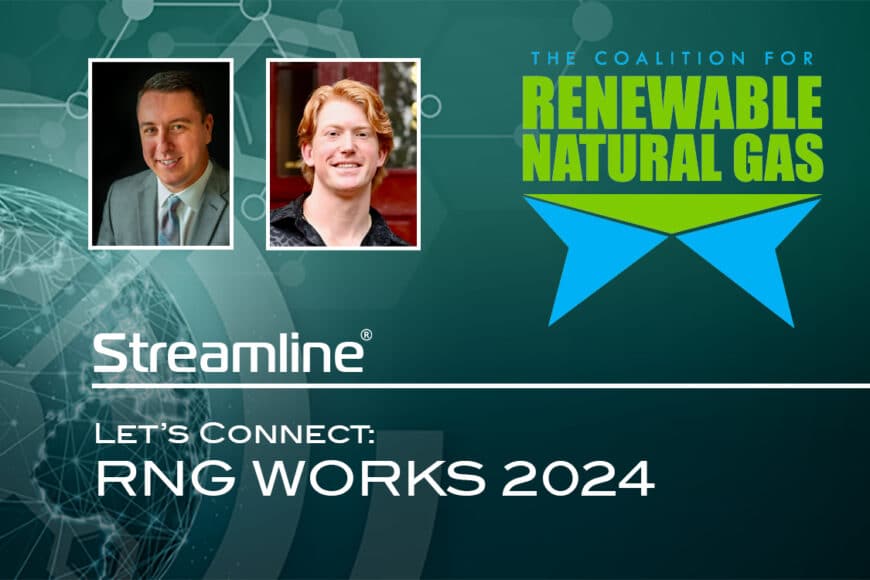
SAN ANTONIO, TX (August 27, 2024) – Parker Jones, Director of Business Development with Streamline Innovations, Inc. (“Streamline”) will be attending the RNG WORKS 2024 Technical Workshop and Trade Expo on September 10-12, 2024.

The conference venue is the Music City Center in Nashville, Tennessee. Interested parties are invited to contact Jacob Pratt to schedule a meeting to learn more about Streamline’s solutions for removing H2S from biogas produced from Anaerobic Digestion processes and Landfills.

READ MORE: Biogas-to-RNG Upgrading Solutions

Streamline’s proven biodegradable chemistry and processes convert toxic H2S into OMRI Certified organic elemental sulfur and water, which can be cleanly disposed of or used in agriculture as fertilizer. Many alternative treatment solutions result in hazardous or toxic byproducts that require special handling. In addition, Streamline’s chemistry is regenerative, leaving a small environmental footprint and consuming much less raw materials than scavengers and adsorbent media, while handling changes in flow and concentration better than biological solutions.

VALKYRIE® Biogas-to-RNG Upgrading Technology – A Green Solution forTreating H2S

The VALKYRIE ECO Flex H2S treating solution is an expansion of the VALKYRIE ECO product line and utilizes Talon®, our non-toxic, biodegradable liquid redox chemistry for H2S treating in renewable natural gas (RNG) applications.

The VALKYRIE ECO solution is designed specifically for H2S treating in RNG applications focusing on anaerobic digesters and landfills.

All VALKYRIE® H2S treating solutions use TALON® chemistry, a non-toxic and biodegradable Redox substance to remove H2S in an environmentally responsible way. The Simple Elemental Sulfur™ byproduct is approved by Organic Materials Review Institute (OMRI) for use in organic food production.

About RNG WORKS

The RNG WORKS Technical Workshop and Trade Expo is managed by The Coalition for Renewable Natural Gas (RNG Coalition), which serves as the public policy advocate and education platform for Renewable Natural Gas in North America. RNG WORKS says the event is designed for feedstock owners (landfill, wastewater, livestock, agriculture and food processing), RNG project developers, operators, financiers, engineers, equipment providers, manufacturers, technology and service providers, marketers, transporters, fleets, municipalities, universities, utilities and other end-users, consumers and customers who want to better understand RNG project development, operations, deployment and utilization.

Contacts

Jacob Pratt
Senior Vice President – Sales
Streamline Innovations, Inc.
Jacob.Pratt@streamlineinnovations.com

Parker Jones
Director – Business Development
Streamline Innovations, Inc.
parker.jones@streamlineinnovations.com

About Streamline Innovations

Streamline Innovation’s vision is Reducing Emissions Through Technology. We help heavy industry around the world achieve environmental performance objectives, improve sustainability, and transition to a sustainable, low-carbon economy. H2S is present in almost every industrial process in the world. Our technology can be applied across industries, delivering a sustainable solution that eliminates H2S, the leading cause of acid rain, a deadly greenhouse gas dangerous for work and living environments. Streamline believes that achieving the E (“Environmental”) in ESG requires data. Creating intelligent systems that operate effectively and efficiently without human intervention is critical to reducing emissions that harm the environment. We integrate advanced data collection, process control, and analytics in our technologies to provide a total solution for customers. We serve organizations in multiple sectors, including Energy/Oil & Gas, Biogas, Landfill Gas & Renewable Fuels, Municipal Wastewater and Industrial Air & Water.

As operators extend their development beyond the established “fairways” of unconventional shale plays, they are increasingly encountering oil and gas resources containing high levels of hydrogen sulfide (H2S), otherwise known as “sour” assets. Sour oil and gas resources are especially prevalent in the Delaware Basin portion of the Permian Basin, located in New Mexico and West Texas.

Because it is poisonous and highly corrosive, sour gas presents a threat to both human health and infrastructure. When produced with crude oil, sour gas must be treated and transported off the production facility or flared for safety purposes. However, operators are increasingly encountering barriers to developing sour oil and gas resources in the forms of sour takeaway capacity and initiatives to eliminate routine flaring.

In this article, we cover the challenges operators face when developing their sour crude and natural gas assets and offer a solution to help them alleviate the constraints in an environmentally friendly way.


The Constraint of Sour Takeaway

Sour gas requires treatment before it can be distributed to residential, commercial, and industrial customers. Traditionally, sour gas has been flared or combusted to convert the contaminated gas into less harmful substances. However, flaring sour gas produces other pollutants such as sulfur dioxide (SO₂), which contributes to acid rain; volatile organic compounds (VOCs); and nitrogen oxides (NOx), which can react with particulates and sunlight to form ozone. Additionally, incomplete combustion may release raw H2S where it can accumulate at the production facility and present a threat to worker safety.

Instead of flaring sour gas, it can be treated and sold as pipeline quality gas. Traditionally, sour gas treating occurs downstream at a gas processing plant operated by the midstream partner. The contaminated gas must be transported using equipment that has been treated and coated to withstand the corrosive effects of sour gas, also known as sour takeaway. Sour takeaway, however, is expensive to install and even if it is available, downstream H2S treating capacity in many regions has not kept pace with the development. Both lack of sour takeaway capacity and downstream H2S treating bottlenecks create significant hurdles for operators.

Without a treating solution in places where flaring is not an option because of regulatory restrictions or voluntary emissions reduction practices, developing sour gas resources must come to a halt.

Debottlenecking – Removing Sour Gas Takeaway Constraints

Operators can debottleneck sour production by installing H2S treating capacity at the well site or production pad for “sweetening” sour gas, effectively removing midstream capacity constraints.

In our article, Gas Sweetening, Sour Gas Treatment Strategies by Volume, we identified the three primary categories of traditional gas treating methods for removing H₂S from produced gas, including (a) scavengers and adsorbents, (b) catalytic reactions, and (c) mechanical destruction or injection. These methods, however, have numerous downsides, including: 

  • Create negative downstream processing effects. 
  • Require the use of chemicals that can be expensive and present a safety risk. 
  • Require the disposal of contaminated media, creating environmental and safety risks. 
  • Operational complexity, requiring frequent oversight on location and problem solving. 

VALKYRIE® H2S Technology for Debottlenecking Sour Gas Production

VALKYRIE H2S treatment technology helps oil and gas operators overcome the constraint of limited sour takeaway capacity, unlocking the value of their sour oil and gas assets. Because VALKYRIE technology safely and effectively treats H2S without flaring or injecting acid gas, it facilitates the achievement of voluntary emissions reduction initiatives and regulatory compliance.

READ MORE: Streamline Innovations VALKYRIE® H2S Treatment Technology Successfully Deployed for Chevron in the Permian Basin

The Liquid Redox (Reduction-Oxidation) process converts H₂S into elemental sulfur and water vapor byproducts using chemistry (Reduction) that can be regenerated and used again with exposure to air (Oxidation).

Using a Next Generation Liquid Redox process, sour gas is directed into a treating vessel containing specialized chemistry and then exits the system sweet (without H₂S) into a gas sales line. The elemental sulfur byproduct is filtered out of the liquid, and the chemistry is then regenerated with exposure to oxygen. The regenerated chemistry is then recirculated back into the treating vessel to perform the reaction again. The regenerative nature of the chemistry reduces media changes, disposal costs and reduces chemical handling requirements on the well site.

The VALKYRIE® H₂S treating solution from Streamline Innovations utilizes relatively recent technological advances in automation control to create the “Next Generation Redox” system. The VALKYRIE system utilizes TALON® chemistry, our non-toxic, biodegradable Redox chemistry.

VALKYRIE technology is a true green solution, by reducing the flaring of sour gas and related emissions at oil and gas production sites by converting H₂S into harmless byproducts, including elemental sulfur certified for use in food production.  

The Streamline VALKYRIE H₂S removal system is the next generation of Liquid Redox (Reduction-Oxidation) to cost-efficiently help oil and gas operators unlock the value of sour gas resources and reduce emissions from oil and gas operations.

VALKYRIE Technology Applications 

In addition to debottlenecking sour crude and natural gas production, VALKYRIE H₂S treating units for sour gas sweetening and reducing emissions from oil and gas operations are suitable for a variety of oil and gas applications, including:

Benefits of the VALKRYIE gas treating system: 

  • A green solution that converts H₂S into benign substances including water and elemental sulfur.  
  • Universal application for biogas, landfill gas and oil and gas production.  
  • Widest operating envelope of any H₂S gas treating method extending across the full spectrum of pressures, flow rates and H₂S concentrations.  
  • Treating to established specifications for sales pipelines, gas lift and fuel gas.  
  • Flexibility of placement along the production stream whether at the anaerobic digester, at a landfill, wellhead, refinery, in a direct or tail gas treating configuration.  
  • Meets the most stringent outlet specifications.  

In our 2023 Sustainability Scorecard, the VALKYRIE fleet helped operators avoid 39.7 million pounds of SO2 emissions by eliminating flaring of sour gas, among other benefits.  

READ MORE: Streamline Innovations 2023 Sustainability Scorecard 

Contact us today to learn how VALKYRIE H₂S treating technology can help you reduce emissions from your oil and gas production operations and debottleneck your operations.


About Streamline Innovations 

Streamline Innovation’s vision is Reducing Emissions Through Technology.  We help heavy industry around the world achieve environmental performance objectives, improve sustainability, and transition to a sustainable, low-carbon economy. Streamline Innovations Leads TIME’s List of America’s Top GreenTech Companies of 2024

H₂S is present in almost every industrial process in the world.  Our technology can be applied across industries, delivering a sustainable solution that eliminates H₂S, the leading cause of acid rain, a deadly greenhouse gas dangerous for work and living environments. 

Streamline believes that achieving the E (“Environmental”) in ESG requires data. Creating intelligent systems that operate effectively and efficiently without human intervention is critical to reducing emissions that harm the environment.   We integrate advanced data collection, process control, and analytics in our technologies to provide a total solution for customers. 

We serve organizations in multiple sectors, including Energy/Oil & Gas, Biogas, Landfill Gas & Renewable Fuels, Municipal Wastewater and Industrial Air & Water. 

As oil and gas wells age, natural reservoir pressure diminishes resulting in a natural decline in production rates. Eventually, the well reaches its economic limit when lower production and net revenue no longer cover ongoing operating expenses. It is literally a race against time. Artificial lift methods, however, can extend the life of the well by boosting production and one of the most effective artificial lift techniques is gas lift.  

Gas lift systems inject natural gas into the well casing to assist in lifting liquids to the surface through the production tubing. Operators use gas lift when reservoir pressure declines, water cuts increase and gas-to-oil ratios (GORs) change over time.  

The primary barriers to using gas lift, however, include the availability of natural gas produced at the well site and/or if the produced gas is “sour” and contains high levels of hydrogen sulfide (H₂S). Sour gas presents serious threats to both human health and infrastructure, rendering it unsuitable for gas lift operations. 

Fuel Gas Conditioning – Eliminating H2S and Reducing Emissions  

In situations where sufficient gas is produced at the well site for gas lift, but it is sour gas, operators typically have resorted to purchasing sweet gas (not containing H₂S) from their midstream partner in a practice known as sweet gas buyback. The downside to this approach is that it tends to be expensive.  

Operators with sour gas operations can avoid the expense of buying back sweet gas by treating H₂S on-site. This approach not only ensures a reliable source of gas for gas lift operations but can also lead to cost savings and environmental benefits. 

In areas with sour takeaway constraints, on site field gas conditioning can also significantly mitigate or eliminate the flaring by sweetening sour gas and using it for gas lift and/or selling it to the pipeline. Avoiding the flaring of sour gas also reduces potentially harmful emissions, like sulfur dioxide (SO₂).  

In fact, leading operators including Taprock Resources and Franklin Mountain Energy are using VALKYRIE technology to reduce emissions by sweetening sour gas on site and using it for gas lift operations.  

READ MORE: Taprock Resources Leveraging VALKYRIE® H₂S Treating Technology to Enhance Gas Lift Operations 

READ MORE: Field-Wide Deployment of VALKYRIE® H₂S Treatment Solution Continues in Permian Basin for Franklin Mountain Energy 

VALKYRIE Next Generation Liquid Redox for Emissions Reduction 

The Liquid Redox (Reduction-Oxidation) process converts H₂S into elemental sulfur and water vapor byproducts using chemistry (Reduction) that can be regenerated and used again with exposure to air (Oxidation). 

Using a Next Generation Liquid Redox process, sour gas is directed into a treating vessel containing specialized chemistry and then exits the system sweet (without H₂S) into a gas sales line. The elemental sulfur byproduct is filtered out of the liquid, and the chemistry is then regenerated with exposure to oxygen. The regenerated chemistry is then recirculated back into the treating vessel to perform the reaction again. The regenerative nature of the chemistry reduces media changes, disposal costs and reduces chemical handling requirements on the well site. 

The VALKYRIE® H₂S treating solution from Streamline Innovations utilizes relatively recent technological advances in automation control to create the “Next Generation Redox” system. The VALKYRIE system utilizes TALON® chemistry, our non-toxic, biodegradable Redox chemistry. 

VALKYRIE technology is a true green solution, by reducing the flaring of sour gas and related emissions at oil and gas production sites by converting H₂S into harmless byproducts, including elemental sulfur certified for use in food production.  

The Streamline VALKYRIE H₂S removal system is the next generation of Liquid Redox (Reduction-Oxidation) to cost-efficiently help oil and gas operators unlock the value of sour gas resources and reduce emissions from oil and gas operations. 

VALKYRIE Technology Applications 

In addition to fuel gas conditioning for Gas Lift applications, VALKYRIE H₂S treating units for sour gas sweetening and reducing emissions from oil and gas operations are suitable for a variety of oil and gas applications, including:  

  • De-bottlenecking sour gas takeaway constraints with onsite H₂S treating. 
  • Tail Gas treating. 

Benefits of the VALKRYIE gas treating system: 

  • A green solution that converts H₂S into benign substances including water and elemental sulfur.  
  • Universal application for biogas, landfill gas and oil and gas production.  
  • Widest operating envelope of any H₂S gas treating method extending across the full spectrum of pressures, flow rates and H₂S concentrations.  
  • Treating to established specifications for sales pipelines, gas lift and fuel gas.  
  • Flexibility of placement along the production stream whether at the anaerobic digester, at a landfill, wellhead, refinery, in a direct or tail gas treating configuration.  
  • Meets the most stringent outlet specifications.  

In our 2023 Sustainability Scorecard, the VALKYRIE fleet helped operators avoid 39.7 million pounds of SO2 emissions by eliminating flaring of sour gas, among other benefits.  

READ MORE: Streamline Innovations 2023 Sustainability Scorecard 

Contact us today to learn how VALKYRIE H₂S treating technology can help you reduce emissions from your oil and gas production operations.  


About Streamline Innovations 

Streamline Innovation’s vision is Reducing Emissions Through Technology.  We help heavy industry around the world achieve environmental performance objectives, improve sustainability, and transition to a sustainable, low-carbon economy. Streamline Innovations Leads TIME’s List of America’s Top GreenTech Companies of 2024

H₂S is present in almost every industrial process in the world.  Our technology can be applied across industries, delivering a sustainable solution that eliminates H₂S, the leading cause of acid rain, a deadly greenhouse gas dangerous for work and living environments. 

Streamline believes that achieving the E (“Environmental”) in ESG requires data. Creating intelligent systems that operate effectively and efficiently without human intervention is critical to reducing emissions that harm the environment.   We integrate advanced data collection, process control, and analytics in our technologies to provide a total solution for customers. 

We serve organizations in multiple sectors, including Energy/Oil & Gas, Biogas, Landfill Gas & Renewable Fuels, Municipal Wastewater and Industrial Air & Water. 
Hydrogen sulfide (H2S) is produced from the decomposition of plant and animal matter, with around 90 percent of H2S emissions being naturally sourced. Hot springs and volcanoes also release substantial amounts of H2S. Natural gas containing significant levels of sulfur is termed “sour” and requires treatment before it can be distributed to residential, commercial, and industrial customers. Untreated H₂S is typically flared for safety reasons and to convert it into less dangerous pollutants, but the practice still generates emissions.  

How Sour is Sour?  

Natural gas produced from oil and gas wells is approximately 70-90 percent methane and contains up to 20 percent of heavier hydrocarbons, including ethane, butane, and propane. Gas produced from an oil or gas well typically contains other contaminants, too, including water vapor, sand, oxygen, carbon dioxide, nitrogen, and in many cases, hydrogen sulfide.  

There is no one set definition of what constitutes “sour” gas, because concentration levels can vary widely from area to area. The Texas Railroad Commission, however, defines sour gas as having an H2S concentration of 100 ppm or more as noted in Statewide Rule 36, which provides  provides sour gas operating requirements to safeguard worker and community safety (source: Statewide Rule 36).  

READ MORE: What Makes an H2S Treating Solution “Green”?

How Does Sour Gas Cause Emissions?  

Sour gas presents a threat to both human health and infrastructure. Sour gas production must be produced and transported using equipment specialized for “sour service,” treated and coated to withstand the corrosive effects of sour gas and is subject to stringent maintenance regimes. In some cases, very high levels of H2S contamination (10,000 ppm or greater) may require onsite gas treatment to reduce H2S to lower levels suitable for sour service handling. Otherwise, these assets cannot be produced.  

Traditionally, sour gas has been flared or combusted to transform the contaminated gas into less harmful substances. However, flaring sour gas produces other pollutants such as sulfur dioxide (SO₂), which contributes to acid rain; volatile organic compounds (VOCs); and nitrogen oxides (NOx), which can react with particulates and sunlight to form ozone. Additionally, incomplete combustion may release raw H2S into the atmosphere. 

Restrictions on flaring are increasingly stringent due to both regulatory mandates and voluntary industry efforts. For instance, the North Dakota Industrial Commission, which regulates the Oil and Gas industry in that state, requires operators to capture 90% of produced gas and reduce flaring. In New Mexico, the Oil Conservation Commission requires upstream and midstream operators to reduce routine natural gas flaring and venting by 98% by 2026.  

The U.S. Environmental Protection Agency has also recently revised its emissions regulations in NSPS OOOOb and EG OOOOc, aiming to phase out all non-emergency flaring in the future. 

Many operators have committed to voluntary emissions reduction programs. The Oil and Gas Methane Partnership 2.0 (OGMP 2.0) has emerged as an influential industry group who members include many large operators with producing assets in the United States and worldwide. OGMP 2.0 has developed a framework for estimating and reporting emissions from oil and gas operations, including emissions from tank venting, purging, and flaring.  

Gas Sweetening 

The process of treating sour natural gas to remove H2S so it can be sold instead of flared, generating emissions, is called “sweetening.”  

In our article, Gas Sweetening, Sour Gas Treatment Strategies by Volume, we identified the three primary categories of traditional gas treating methods for removing H₂S from produced gas, including (a) scavengers and adsorbents, (b) catalytic reactions, and (c) mechanical destruction or injection. These methods, however, have numerous downsides, including: 

  • Create negative downstream processing effects. 
  • Require the use of chemicals that can be expensive and present a safety risk. 
  • Require the disposal of contaminated media, creating environmental and safety risks. 
  • Operational complexity, requiring frequent oversight on location and problem solving. 

Valkyries Reduce Oil & Gas Emissions Using Next Generation Liquid Redox for H2S Treating 

The Liquid Redox (Reduction-Oxidation) process converts H₂S into elemental sulfur and water vapor byproducts using chemistry (Reduction) that can be regenerated and used again with exposure to air (Oxidation). 

Using a Next Generation Liquid Redox process, sour gas is directed into a treating vessel containing specialized chemistry and then exits the system sweet (without H₂S) into a gas sales line. The elemental sulfur byproduct is filtered out of the liquid, and the chemistry is then regenerated with exposure to oxygen. The regenerated chemistry is then recirculated back into the treating vessel to perform the reaction again. The regenerative nature of the chemistry reduces media changes, disposal costs and reduces chemical handling requirements on the well site. 

The VALKYRIE® H₂S treating solution from Streamline Innovations utilizes relatively recent technological advances in automation control to create the “Next Generation Liquid Redox” system. The VALKYRIE system utilizes TALON® chemistry, our non-toxic, biodegradable Redox chemistry. 

VALKYRIE technology is a true green solution, by reducing the flaring of sour gas and related emissions at oil and gas production sites by converting H₂S into harmless byproducts, including elemental sulfur certified for use in food production.  

READ MORE: Streamline’s Sulfur from H2S Receives Listing as an input for Organic Food Production 

The Streamline VALKYRIE H₂S removal system is the next generation of Liquid Redox (Reduction-Oxidation) to cost-efficiently help oil and gas operators unlock the value of sour gas resources and reduce emissions from oil and gas operations. 

VALKYRIE Technology Applications 

VALKYRIE H₂S treating units for sour gas sweetening and reducing emissions from oil and gas operations are suitable for a variety of oil and gas applications, including:  

  • De-bottlenecking sour gas takeaway constraints with onsite H₂S treating. 
  • Fuel gas conditioning for Gas Lift to minimize sweet gas buyback. 
  • Tail Gas treating. 

VALKYRIE gas treating units have been operating reliably for oil and gas producers in the Permian Basin and elsewhere, including Chevron Corporation, Franklin Mountain Energy, and Taprock Energy, among others. 

Benefits of the VALKRYIE gas treating system: 

  • A green solution that converts H₂S into benign substances including water and elemental sulfur. 
  • Universal application for biogas, landfill gas and oil and gas production. 
  • Widest operating envelope of any H₂S gas treating method extending across the full spectrum of pressures, flow rates and H₂S concentrations. 
  • Treating to established specifications for sales pipelines, gas lift and fuel gas. 
  • Flexibility of placement along the production stream whether at the anaerobic digester, at a landfill, wellhead, refinery, in a direct or tail gas treating configuration. 
  • Meets the most stringent outlet specifications. 

In our 2023 Sustainability Scorecard, the VALKYRIE fleet helped operators avoid 39.7 million pounds of SO2 emissions, among other benefits.  

READ MORE: Streamline Innovations 2023 Sustainability Scorecard 

Contact us today to learn how VALKYRIE H₂S treating technology can help you reduce emissions from your oil and gas production operations.  


About Streamline Innovations

Streamline Innovation’s vision is Reducing Emissions Through Technology.  We help heavy industry around the world achieve environmental performance objectives, improve sustainability, and transition to a sustainable, low-carbon economy. Streamline Innovations Leads TIME’s List of America’s Top GreenTech Companies of 2024.

H2S is present in almost every industrial process in the world.  Our technology can be applied across industries, delivering a sustainable solution that eliminates H2S, the leading cause of acid rain, a deadly greenhouse gas dangerous for work and living environments.

Streamline believes that achieving the E (“Environmental”) in ESG requires data. Creating intelligent systems that operate effectively and efficiently without human intervention is critical to reducing emissions that harm the environment.   We integrate advanced data collection, process control, and analytics in our technologies to provide a total solution for customers.

We serve organizations in multiple sectors, including Energy/Oil & Gas, Biogas, Landfill Gas & Renewable Fuels, Municipal Wastewater and Industrial Air & Water.
H2S Treatment Technology That Keeps Your Dairy Digester to RNG Operation Green

Agricultural biogas streams are important feedstocks for upgrading to Renewable Natural Gas (RNG). Before biogas from a dairy digester or similar facility can be sold to a commercial pipeline as RNG, it must be treated for hydrogen sulfide (H2S) contamination. For a dairy digester biogas-to-RNG project to live up to its green value proposition, however, project designers have to consider not just the efficient aggregation of manure and capturing methane from the digester, but also the byproducts of the upgrading process itself.

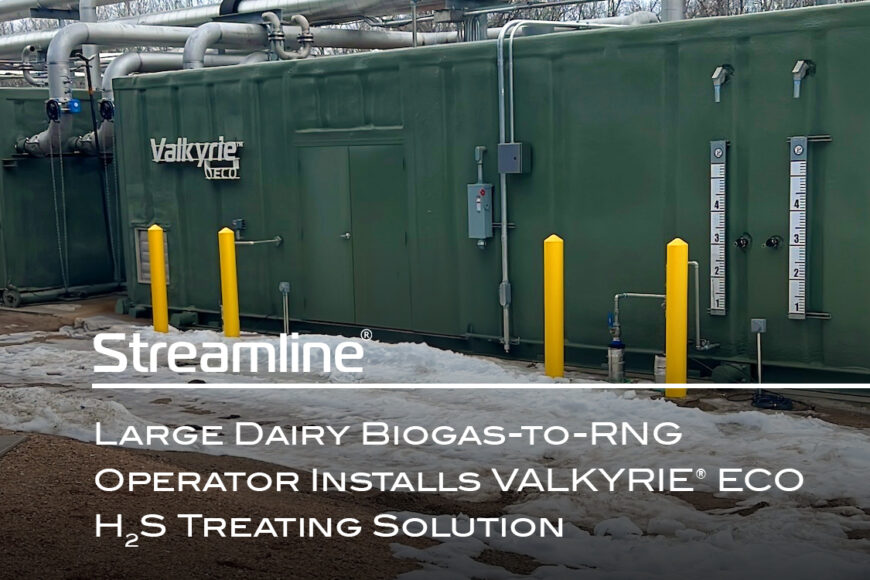
READ MORE: Large Agricultural Biogas-to-RNG Operator Installs Streamline Innovations VALKYRIE® ECO H2S Treating Solution

Green H2S Treating Methods

There are several methods for treating H2S in dairy digester biogas-to-RNG applications, but only two are truly “green” from the standpoint of not creating negative byproducts: Biologic solutions and Next Generation Liquid Redox.

READ MORE: What Makes an H2S Treating Solution “Green”?

Biologic H2S Treating Systems

Biological processes are green because they utilize natural microorganisms to convert H2S into non-harmful compounds. However, this strength is also the primary weakness of biologic treating solutions. Living organisms are not as predictable or consistent as known chemical processes.

Downsides of biologic H2S treating options:

  • Because the bacteria colony in a biologic treater acclimates to the amount of H2S it consumes, biologics are highly sensitive to variations in gas flow rates, temperatures, and H2S concentrations, making the entire system more prone to unplanned downtime and lengthy restarts.
  • Usually require a complex and costly installation.
  • Typically require long initial start-up times to allow a critical mass of microorganisms to grow.
  • Often require additional equipment to maintain a steady state, increasing the cost of these systems and adding operational complexity.

Next Generation Liquid Redox (VALKYRIE®)

The next generation of liquid redox solutions, such as VALKYRIE Biogas-to-RNG technology, provide operators of dairy digester plants with a H2S purification solution that is not only green, but operationally robust. Like biological H2S treating options, VALKYRIE technology is a green solution, but unlike biologics delivers high reliability and fast startups.

Upsides to VALKYRIE technology:  

  • Reacts quickly to changes in gas flow, temperatures, and H2S concentrations for high reliability, process stability, and uptime.
  • Simple, cost effective “plug and play” installation
  • One-button, fast startup.

Additionally, VALKYRIE technology extracts elemental sulfur from the gas stream that can be sold as Simple Elemental Sulfur™ for use in organic food production, advancing the circular economy concept.

LEARN MORE: VALKYRIE® Biogas-to-RNG Upgrading Technology

In summary, Streamline Innovation’s VALKYRIE H2S treating technology offers dairy digester biogas-to-RNG operators the most reliable, green option for removing H2S from gas streams in the biogas-to-RNG upgrading process.

Contact us today to learn more about how VALKYRIE ECO and ECO FLEX solutions can help you achieve your agricultural biogas-to-RNG upgrading needs.


About Streamline Innovations

Streamline Innovation’s vision is Reducing Emissions Through Technology.  We help heavy industry around the world achieve environmental performance objectives, improve sustainability, and transition to a sustainable, low-carbon economy. Streamline Innovations Leads TIME’s List of America’s Top GreenTech Companies of 2024.

H2S is present in almost every industrial process in the world.  Our technology can be applied across industries, delivering a sustainable solution that eliminates H2S, the leading cause of acid rain, a deadly greenhouse gas dangerous for work and living environments.

Streamline believes that achieving the E (“Environmental”) in ESG requires data. Creating intelligent systems that operate effectively and efficiently without human intervention is critical to reducing emissions that harm the environment.   We integrate advanced data collection, process control, and analytics in our technologies to provide a total solution for customers.

We serve organizations in multiple sectors, including Energy/Oil & Gas, Biogas, Landfill Gas & Renewable Fuels, Municipal Wastewater and Industrial Air & Water.

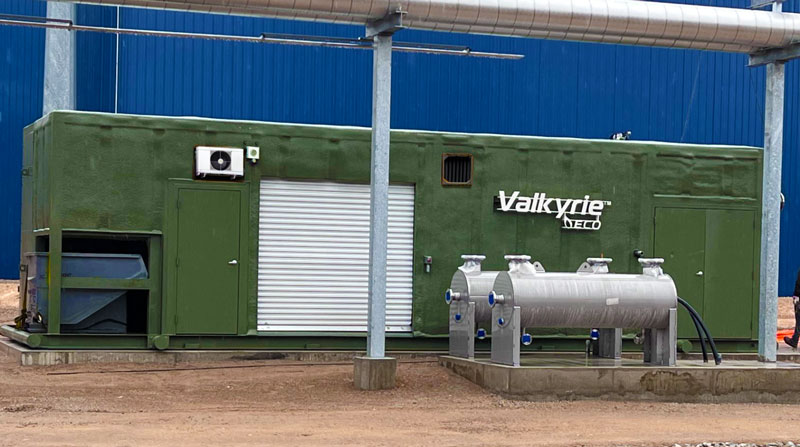
  • This new installation of two VALKYRIE ECO units at a Biogas-to-RNG project expands utilization of Streamline technology for treating H2S in the biogas upgrading process.
  • VALKYRIE ECO technology converts H2S into a single byproduct: OMRI certified organic Simple Elemental Sulfur with multiple agricultural use cases.
VALKYRIE ECO - Technology to remove H2S from Biogas

June 3, 2024. Streamline Innovations today announced the successful installation and startup of two VALKYRIE® ECO  H2S treating units at a Biogas-to-RNG project for a new customer.

The VALKYRIE ECO units remove H2S from the biogas created by the anaerobic digestor, which aggregates manure from multiple dairies in the area. This is the first step in upgrading the gas to meet the pipeline specification of the local natural gas utility.

VALKYRIE ECO H2S Treating System Highlights:

  • Gas flow capacity  ranges from 500 SCFM at 0 psig to 674 SCFM at 12 psig.
  • Effectively treats up to 10,000+ PPM H2S continually to pipeline specification.
  • Internal recycle loop allows for infinite turndown.
  • Simple installation and fast, single-button startup help meet project timeline.
  • Resilient chemical reaction remains unaffected by variability in gas flow, temperature, and H2S concentration resulting in high uptime.
  • Modular design makes it simple and cost-effective to scale treating capacity.
  • Single byproduct of Simple Elemental Sulfur™ certified by OMRI for use in organic food production.
  • Enclosed climate-controlled skid for optimal operation in all environments.

LEARN MORE: VALKYRIE® Biogas-to-RNG Upgrading Technology

The VALKYRIE ECO H2S treating system is based on the same TALON® next-generation Redox technology successfully working in the oil and gas industry, only scaled down for smaller gas flow volumes and lower pressures typically found in Biogas-to-RNG applications.


Contact us today to learn more about how VALKYRIE ECO and ECO FLEX H2S treating technology can help you achieve your Biogas-to-RNG upgrading needs.

Contact

Jacob Pratt
Senior Vice President – Sales
Streamline Innovations, Inc.
jacob.pratt@streamlineinnovations.com

Parker Jones
Director – Business Development
Streamline Innovations, Inc.
parker.jones@streamlineinnovations.com

About Streamline Innovations

Streamline Innovation’s vision is Reducing Emissions Through Technology.  We help heavy industry around the world achieve environmental performance objectives, improve sustainability, and transition to a sustainable, low-carbon economy.

H2S is present in almost every industrial process in the world.  Our technology can be applied across industries, delivering a sustainable solution that eliminates H2S, the leading cause of acid rain, a deadly greenhouse gases dangerous for work and living environments.

Streamline believes that achieving the E (“Environmental”) in ESG requires data. Creating intelligent systems that operate effectively and efficiently without human intervention is critical to reducing emissions that harm the environment.   We integrate advanced data collection, process control, and analytics in our technologies to provide a total solution for customers.

We serve organizations in multiple sectors, including Energy/Oil & Gas, Biogas, Landfill Gas & Renewable Fuels, Municipal Wastewater and Industrial Air & Water.
SAN ANTONIO, TX (April 26, 2024) – Jacob Pratt, Senior Vice President of Sales, and Parker Jones, Director of Business Development, both with Streamline Innovations, Inc. (“Streamline”) will be attending BIOGAS AMERICAS 2024 on May 13-16, 2024.

Interested parties are invited to contact Jacob Pratt to schedule a meeting to learn more about Streamline’s solutions for removing H2S from biogas produced from Anaerobic Digestion and Landfills.

Meetings will be hosted in the Champion’s Suite, followed by a happy hour starting at 4:00 PM. Stop by to enjoy catered food, drinks, and the balcony overlooking the golf course.

Streamline’s proven biodegradable chemistry and processes convert toxic H2S into OMRI Certified elemental sulfur and water, which can be cleanly disposed of or used in agriculture as fertilizer. Many alternative treatment solutions result in hazardous or toxic byproducts that require special handling.  In addition, Streamline’s chemistry is regenerative, leaving a small environmental footprint and consuming much less raw materials than scavengers and adsorbent media, while handling changes in flow and concentration better than biological solutions.

VALKYRIE® Biogas-to-RNG Upgrading Technology – A Green Solution for Treating H2S

The VALKYRIE ECO Flex H2S treating solution is an expansion of the VALKYRIE ECO product line and utilizes Talon®, our non-toxic, biodegradable liquid redox chemistry for H2S treating in renewable natural gas (RNG) applications.

The VALKYRIE ECO solution is designed specifically for H2S treating in RNG applications focusing on anaerobic digesters and landfills.

Our VALKYRIE® H2S treating solutions use TALON® chemistry, a non-toxic and biodegradable Redox substance to remove H2S in an environmentally responsible way. The Simple Elemental Sulfur™ byproduct is approved by Organic Materials Review Institute (OMRI) for use in organic food production.

About BIOGAS AMERICAS

Biogas Americas is organized by the American Biogas Council and describes itself as the voice of the US biogas industry dedicated to maximizing carbon reduction and economic growth using biogas systems. Whether you are a project developer, equipment supplier, service provider, operator, investor, utility, policy-maker, or anyone whose success depends on the growth and profitability of biogas as a resource, the event bills itself as a way to build your business and stay informed of the latest developments in the industry.

More information about the conference can be found on the conference website.

Contact

Jacob Pratt
Senior Vice President – Sales
Streamline Innovations, Inc.
jacob.pratt@streamlineinnovations.com

Parker Jones
Director – Business Development
Streamline Innovations, Inc.
parker.jones@streamlineinnovations.com

About Streamline Innovations

Streamline Innovation’s vision is Eliminating Emissions Through Technology.  We help heavy industry around the world achieve environmental performance objectives, improve sustainability, and transition to a sustainable, low-carbon economy.

H2S is present in almost every industrial process in the world.  Our technology can be applied across industries, delivering a sustainable solution that eliminates H2S, the leading cause of acid rain, a deadly greenhouse gases dangerous for work and living environments.

Streamline believes that achieving the E (“Environmental”) in ESG requires data. Creating intelligent systems that operate effectively and efficiently without human intervention is critical to reducing emissions that harm the environment.   We integrate advanced data collection, process control, and analytics in our technologies to provide a total solution for customers.

We serve organizations in multiple sectors, including Energy/Oil & Gas, Biogas, Landfill Gas & Renewable Fuels, Municipal Wastewater and Industrial Air & Water.
Landfill Gas (LFG) streams are important feedstocks for upgrading to Renewable Natural Gas (RNG). Before LFG can be sold to a commercial pipeline as RNG, it must be treated for hydrogen sulfide (H2S) contamination. One of the key factors in comparing H2S treating alternatives in LFG-to-RNG projects is the ability to reduce H2S levels to non-detect levels to meet pipeline specification.

Meeting Pipeline Specification

LFG-to-RNG project developers and operators have several options for treating H2S in landfill gas streams having various levels of effectiveness at reducing or eliminating H2S contamination. And, some H2S treatment methods are more resilient than others within their operating envelopes.

As a practical matter, the most important threshold is pipeline specification and more specifically the pipeline spec for the utility that will be taking the RNG.

READ MORE: Meeting RNG Pipeline Specifications – The H2S Imperative

As previously noted in our article Gas Treating – Processing Solutions for Multiple Industries, the University of Texas found that the interstate pipeline specifications for H2S range between 0.25 grains per 100 standard cubic feet to 1.0 grains.

Going All the Way – Treating to Non-Detect

Utilizing Talon®, our non-toxic, biodegradable liquid redox chemistry, the Valkyrie® ECO and ECO FLEX solutions are designed specifically for H2S treating in Renewable Natural Gas (RNG) applications.

VALKYRIE technology treats H2S down to non-detect levels, ensuring your LFG feedstock will meet pipeline requirements consistently from a single skid (no additional equipment required).

  • VALKYRIE ECO is the solution for H2S concentrations up to 10,000 PPM for gas volumes ranging from 0 to 1,350 SCFM.
  • VALKYRIE ECO FLEX is the solution for H2S concentrations up to 14,500 PPM for gas volumes ranging from 1,351 to 25,000 SCFM in single packages. The VALKYRIE ECO FLEX model uses a modular design that allows customers to scale treating capacity to meet your changing needs. 

LEARN MORE: VALKYRIE® Biogas-to-RNG Upgrading Technology

Other benefits of the VALKYRIE ECO and ECO FLEX solutions include:

  • Non-biologic, robust and sustainable solution.
  • Modular design made to scale to needs at site.
  • Ultra-low pressure with no pressure loss across the treating unit.
  • Operates continuously without shutdowns for media changes.
  • Does not introduce oxygen into the gas stream.

In summary, Streamline Innovation’s VALKYRIE H2S treating technology offers landfill gas operators the most reliable, green option with infinite turndown to bring H2S in LFG streams down to non-detect levels for consist delivery of RNG that meets pipeline specifications.  

Contact us today to learn more about how VALKYRIE ECO and ECO FLEX solutions can help you achieve your LFG-to-RNG upgrading needs.

About Streamline Innovations

Streamline Innovation’s vision is Reducing Emissions Through Technology.  We help heavy industry around the world achieve environmental performance objectives, improve sustainability, and transition to a sustainable, low-carbon economy. Streamline Innovations Leads TIME’s List of America’s Top GreenTech Companies of 2024.

H2S is present in almost every industrial process in the world.  Our technology can be applied across industries, delivering a sustainable solution that eliminates H2S, the leading cause of acid rain, a deadly greenhouse gas dangerous for work and living environments.

Streamline believes that achieving the E (“Environmental”) in ESG requires data. Creating intelligent systems that operate effectively and efficiently without human intervention is critical to reducing emissions that harm the environment.   We integrate advanced data collection, process control, and analytics in our technologies to provide a total solution for customers.

We serve organizations in multiple sectors, including Energy/Oil & Gas, Biogas, Landfill Gas & Renewable Fuels, Municipal Wastewater and Industrial Air & Water.